Showing posts with label Animation. Show all posts

Thursday, December 27, 2012

The Pixar is strong in this one

Wreck-It Ralph
My rating:


As I have previously mentioned, it is not the best of times to be a Pixar fan. A couple of disappointing releases have slightly tarnished its record of knockout successes - slightly, because a disappointing Pixar film is still a pretty good animated family film by all but its own standards. Wreck-It Ralph is not a Pixar release, but it cannot avoid the comparison; it's still a Disney film, and has John Lasseter as an executive producer. More obviously, its premise of videogame characters with inner lives and personalities of their own not only recalls the Toy Story series, but also A Bug's Life, Finding Nemo and Cars - in Pixar's penchant for creating anthropomorphosized, richly-detailed worlds that also provide opportunities for lots and lots of in-jokes. And its 87% score on RottenTomatoes has already trumped Pixar's last two (Brave scored 79%, Cars 2 38%), raising the possibility that perhaps the parent company is beating them at the game they used to rule.

Perhaps. But only because of what they learned from them.

Wreck-It Ralph (John C. Reilly) is the villain of the Fix-It Felix, Jr. video game at Litwak's Arcade, and he is not very popular. While Felix (Jack McBrayer) is nightly celebrated by the inhabitants of their gameworld, Ralph doesn't even get invited to their game's 30th anniversary party. Wanting to be a hero for a change, Ralph sneaks into Hero's Duty, a 1st-person-shooter game - in which Sergeant Calhoun (Jane Lynch) is the main character - in order to win a hero's medal. He ends up in Sugar Rush, a kart-racing game, and meets Vanellope Von Schweetz (Sarah Silverman), a character with a sad story of her own: she's a "glitch", equally shunned by everyone in her candyland gameworld, and forbidden to participate in the races by King Candy (Alan Tudyk). Ralph and Vanellope partner up to get her in a race and win him his medal, and a friendship grows between the two. But if Ralph isn't in his game, Mr. Litwak will junk their console - and as Felix teams up with Calhoun to find him, they learn that a Cy-Bug monster from Hero's Duty has infected Sugar Rush, thus threatening to destroy two video game worlds.

The trailer prominently features a scene at Bad-Anon, a support group for video game villains, presided by one of the Pac-Man ghosts (Clyde, if you must know) and in which Zangief from Street Fighter, Bowser from Super Mario Bros and Doctor Eggman from Sonic the Hedgehog all make prominent cameos.  It's a hilarious scene, and it encapsulates much of Wreck-It Ralph's appeal: appearances by fan-favourite videogame characters, clever in-jokes, and a commitment to fleshing out the inner worlds of videogames right down to the characters. This is one movie you'll want on Bluray DVD so you can pause and admire all the visual detail - from the tiny cameos by more videogame characters (Chun-Li makes at least two appearances if I recall correctly) to the fact that Game Central Station, the terminal in between game machines, is literally a giant multi-plug socket on the inside.

Which is, of course, exactly what you expect of a Disney animated film, even a non-Pixar one. What matters more is a strong emotional throughline that makes us care about the characters, especially our titular hero. And it's there; on one level, we feel for Ralph when he's unappreciated and ostracised from his own gameworld - but on a deeper level, it's about his need to define himself beyond his assigned label as videogame bad guy. Which is echoed by Vanellope, a malfunctioning character in her game who just wants to participate like the rest of her peers. They go from annoying each other - well, more like Vanellope annoying Ralph - to a deep and heartwarming friendship based on their common desires and helping each other realise them.

It's just... we've seen this kind of thing before. Not just the funny anthropomorphosized world, but also the unlikely-friendship storyline. Two wildly differing characters will meet, bicker, then grow in affection towards each other, only to have a heartbreaking fall out, before reconciling in time for a triumphant climax. It's in the majority of Pixar films, as well as most animated films from other studios as well - in fact, come to think of it, it's the classic romantic comedy formula that goes way back beyond Pixar. Which gives Wreck-It Ralph a been-there-done-that feel that's just a little disappointing. It feels like Walt Disney Animation Studios - through director Rich Moore, and writers Phil Johnston, Jennifer Lee and John Reardon - is trying too hard to make a Pixar-ish film and deliberately aping their formula.

Which isn't to say their formula doesn't still work. The fall out is still effectively sad, as is the triumphant and uplifting climax. The jokes are funny, the action scenes are exciting, and the voice acting is terrific. (I did not recognise Alan Tudyk there.) But I wish the film had spent more time exploring other video games instead of staying in Sugar Rush for most of its second half; the videogame in-jokes are replaced by candy and confectionery in-jokes, most of which I didn't get. And having Felix and Calhoun fall for each other is a subplot that I didn't enjoy; Felix is uninteresting and poorly-defined for all the screentime he gets, and a character like Calhoun is an ill fit as a romantic interest. Lastly, there just isn't much depth here, nothing more emotionally resonant beyond its be-yourself/be-whatever-you-want-to-be message - which is yet another thing that's been done over and over again in animated films.

Am I expecting too much of this movie? Perhaps I am. Thing is, Pixar is (usually) better than this. They don't always recycle the formula, as with The Incredibles and Wall-E. Even when they followed it, they're daring enough to explore new narrative and thematic territory, as with Up and Toy Story 2 and 3. They've raised the bar high enough that a film like this - even as well-crafted and heartfelt as it is - just clears it instead of soaring above it. To be honest, I might even prefer something as ambitiously flawed as Brave than something content to merely be the Pixar film Pixar never made. Guess I'm a Pixar fanboy through and through; I'm still waiting for their next to knock all our socks off.

NEXT REVIEW: The Hobbit: An Unexpected Journey
Expectations: tempered

Thursday, November 22, 2012

"Best 3D Animated Feature Film" my ass

War of the Worlds: Goliath
My rating:


As soon as I got home from this movie, I Googled the Los Angeles 3D Film Festival straight away. Y'see, these are the guys who named this movie their Best Animated 3D Feature Film, beating out nominees that included major Hollywood releases such as ParaNorman and Madagascar 3. From what I can tell from their website, their raison d'etre is, indeed, the 3D film medium, the promotion of such, and the defense against any intimation that it's just a fad whose time will pass. So I'm guessing here that their idea of "best", when it comes to giving out their awards (and I have not been able to find out who their judges were - if they had any), refers to the purely technical quality of their 3D effects. And since I didn't watch this movie in 3D, I guess I missed out on its international-award-winning qualities.

Because by every other standard of filmmaking, War of the Worlds: Goliath suuuucks.

In 1899, the Martians attacked Earth - but were defeated by infections from the bacteria in our air. Fifteen years later, our technology has improved by leaps and bounds due to reverse-engineering the Martian war machines. As a child, Eric Wells (Peter Wingfield) witnessed the death of his parents during the first invasion; now he is a Captain in the A.R.E.S. (Allied Resistance Earth Squadrons) multinational force formed to combat the extraterrestrial threat, led by Secretary of War Theodore Roosevelt (Jim Byrnes) and General Kushnirov (Rob Middleton). He and his crew - comprising Jennifer Carter (Elizabeth Gracen), Patrick O'Brien (Adrian Paul), Shah (Tony Eusoff) and Abraham Douglas (Beau Billingsley) - receive command of the Goliath, their latest and most advanced battle tripod. But it comes not a moment too soon - because the Martians have returned, this time stronger than ever.

Yes, this is indeed a made-in-Malaysia film, because it's production company Tripod Films is a homegrown outfit. This despite the fact that its director (Joe Pearson), screenwriter (David Abramowitz), executive producer (Kevin Eastman) and majority of the voice cast (a bunch of former cast members of that '90s Highlander TV show) are all, um, "import players". Not that hiring import players is a bad thing, had it actually produced a good movie. But Joe Pearson is an animation director of much experience but little distinction; David Abramowitz is known only for the aforementioned Highlander TV series, several episodes of MacGyver and V from the '80s, and a direct-to-video Highlander anime spinoff movie; and Kevin Eastman is a co-creator of Teenage Mutant Ninja Turtles, but it appears his name is attached to this solely because he holds the film rights for the Heavy Metal comic magazine, and this movie is based on one of the comic storylines. Not that I want to get nasty on these gentlemen, or imply that they are incapable of producing good work. But the fact is, they did terrible work here.

I had misgivings the moment I laid eyes on that poster. Look at those character designs. Do they look any better than a cheapo '90s Saturday morning cartoon? Oh, I thought, maybe they'll look better in motion, maybe the animation could be good. But it isn't. And it isn't even just the technical quality that's lacking; everything about the animation is lame and uninspired. From the way the characters move, to the palette of about 4 or 5 emotions each character's face is limited to, to the boring and unimaginative - and interminable - action scenes, to the fact that every male character has broader shoulders than a WWE wrestler. This is TV-quality animation; worse, it's TV-quality animation from at least 15 years ago. Charging cinema ticket prices (and 3D cinema ticket prices at that) for this is criminal.

Okay, there are the 3D-animated mechs, airships, WW1-era triplanes and Martian walkers - and the animation on these is jerky and cheap too. Which I could forgive if their designs were more imaginative, or even more true to the steampunk aesthetic that the movie is being advertised on. Considering the time period - and considering the fact that none of these vehicles appear to be running on steam - it's closer to dieselpunk, and this distinction is actually important to the fans you're advertising your movie to. Worst of all, the designs are dull. Every mech is a similar-looking, three-legged, boxy mass of guns that doesn't even look like a credible piece of early-20th-century technology.

And the storyline, the dialogue... good God, is Abramowitz really an experienced and produced Hollywood screenwriter? Was Highlander ever this bad? (I only watched a few episodes; I know the show has its fans, but I was never one.) Or did he just half-ass this screenplay? I think he half-assed this screenplay. The plot is slapdash, the characterisation is nonexistent, and the dialogue sounds like an extremely rushed first draft that Abramowitz never bothered to turn into a second draft. Even the character names are dull; they might as well have names like Girly McFemale and Paddy O'Stereotype. Like the animation quality, it's all lame and uninspired. The voice actors certainly can't do a damn thing with the dialogue - not even geek-cred luminaries like Adam Baldwin (Firefly, Chuck) and Mark Sheppard (Battlestar Galactica, Supernatural), both wasted in extremely minor roles. Adrian Paul sounds positively bored out of his skull reading his lines. 

Oh, there's a Malaysian character in here. Shah is actually Raja Iskandar Shah, a Malay prince exiled from his royal court for joining A.R.E.S., and he's played by our very own Tony Eusoff. And at one point, he kills a Martian with a keris. Yay, Malaysia Boleh! (He also delivers one laughable line of Malay dialogue that I bet my right pinky will get cut out of international releases.) So with this ridiculous attempt at pandering to the homebase, are we supposed to be proud of this movie? No. There is nothing to be proud of - not even your meaningless award from an inconsequential film festival. Sorry guys; your movie sucks. It will satisfy no one other than 7-year-old children of harried parents rummaging through discount DVD bins looking for something to keep the little brats quiet for 82 minutes. 

NEXT REVIEW: The Twilight Saga: Breaking Dawn part 2
Expectations: well, it's finally over 

Saturday, July 7, 2012

Bravely facing disappointment

Brave
My rating:


The past couple of years haven't been the best of times to be a Pixar fanboy. Or at least, compared to the few years before then, when they had Ratatouille, Wall-E, Up and Toy Story 3 coming out one after the other. And even before then - before Cars, widely regarded as their first misstep - they had a string of massive successes stretching from The Incredibles all the way to the first Toy Story. It all started when they announced that their next film after Toy Story 3 would be Cars 2, a sequel to their least-liked movie and a not-inconsiderable critical disappointment - and although I still liked it, it was still a clear step down from their usual standard. So as any fanboy would, I placed high hopes on Brave, their 13th animated feature, to mark a return to their form.

And it pains me - despite the movie being pretty good, and one that I enjoyed quite a bit - to say that it isn't.

Merida (Kelly Macdonald), princess of the clan DunBroch, is a spunky and free-spirited teenage girl who loves shooting her bow and arrow, riding through the Scottish highlands, and generally seeking adventure. But although her father King Fergus (Billy Connolly) indulges her and her three younger triplet brothers, her mother Elinor (Emma Thompson) is a lot more strict. Elinor is trying to bring Merida up to be a proper princess, and has arranged to marry her off to a son of one of three allied clans. Rebelling against her mother's plans for her future, Merida comes across a witch (Julie Walters) and asks her for a spell that will change her mother, and thus change Merida's fate. She only realises what a grave mistake she has made when the spell changes Elinor into a huge black bear - one that her father mistakes for Mor'du, the bear that he once fought years ago and intends to seek revenge upon.

This isn't the first time a Pixar film's originator was taken off his or her own project and replaced with another director. It happened to Jan Pinkava and Ratatouille, amid disturbing rumours of a falling out - but the final product, under the new helm of Brad Bird, turned out just fine. It happened again with Brenda Chapman, to whom Brave was a highly personal story and Pixar's first to feature a female protagonist. This time, the results aren't as good, and it does not achieve the thematic and emotional depths of a truly female-centric film. (Yes, yes, I know, I am a man saying this. Wait. I can prove my point.) And though we may never know what went on behind the scenes, Pixar cannot escape the charge that firing Chapman is the cause of it all. They're not sexist; they couldn't be, if they could create female characters like Jessie the cowgirl, EVE, Helen Parr, even Dory. But Brave proves they can be as blinkered about the female perspective as, well, any all-male group can be.

See, it claims to be a story that's uniquely about mothers and daughters - specifically, the way the former hovers over the latter and the latter chafes under this treatment. I gotta ask: exactly how is this different from Hiccup and Stoick in How to Train Your Dragon? Or Flint and his dad in Cloudy with a Chance of Meatballs? Or any one of dozens of films featuring protagonists with daddy issues? You have your parental figure with expectations of a child that differs from the child's own ambitions, with all that juicy dramatic mix of love, disappointment, resentment and guilt that comes with it. That's exactly what happens with Merida and Elinor, and their story goes through exactly the same paces all those other movies do. (And makes poor use of Fergus, who is reduced to a bystander in the climax and should really have been given more to do considering that's his wife that's been turned into a bear.) In fact, Rapunzel and Mother Gothel in Rapunzel: A Tangled Tale were more interesting, and that film has a greater claim to being a uniquely female story.

That seen-it-before feeling pervades more than just the central mother-daughter relationship. There are echoes of How to Train Your Dragon (the Scottish accents), Hayao Miyazaki's Princess Mononoke (the will-o'-the-wisps) - and most strangely, Disney's own Brother Bear (a human being gets turned into a bear), Rapunzel (the heroine's horse that's almost, but not quite, a cute animal sidekick), and Beauty and the Beast during its climax. I'm not faulting it for not being 100% original - which is an impossible standard anyway, and besides, taking inspiration from such a disparate variety of sources could just as well produce something original. But the other films Brave is reminiscent of are all in the animated genre, which gives the impression not so much that it took inspiration from them, but that it simply didn't know - or care - that it's all been done before.

But as I said, I still enjoyed it quite a bit, as I knew I was going to. The gags are all terrific, in particular one hilarious one involving the witch's automated message system. Beautifully-rendered visuals are practically obligatory for Pixar films, but Merida's unruly shock of bright red hair is a particularly remarkable bit of animation and character design. As derivative as its final moments are, they are still well-crafted enough to stir the necessary emotion, and put a little sting into TMBF's eyes. I also liked how subtly the plot weaved together the witch's spell on Elinor, the demon bear Mor'du, and the legend of a rogue prince that Elinor tells Merida about in the beginning without spelling out the connections. And finally, the soundtrack is gorgeous and stirring; you simply can't go wrong with Gaelic hymns and traditional Scottish sounds. This is a movie worth sitting through the entire end credits - both for the music, and the funny post-credits scene.

Still, this is a disappointment. I hadn't expected much from Cars 2, and I was willing to allow Pixar their one revisit to their biggest cash cow - but this one I was hoping to be the one that got them back into their groove. It isn't. It had all the potential to be, but the magic simply wasn't happening. Which is a bitter pill to swallow for a Pixar fanboy like myself, so I'm thinking maybe it's time I cooled my enthusiasm. Maybe their winning streak has finally come to an end; maybe it's finally become too much to expect greatness from every single Pixar film. Their next, Monsters University - a prequel to Monsters, Inc. - certainly doesn't look like it'll be anything more than an entertaining trifle - which, ultimately, also describes Brave. So I think I'll do just that: expect every new Pixar movie to be merely good, instead of yet another of the finest animated films ever made. That's not something to be ashamed of... is it?

NEXT REVIEW: The Amazing Spider-Man
Expectations: so, what's new?

Monday, March 26, 2012

Not worth seeing

Seefood
My rating:


I know, I know, I've been greatly remiss on reviews recently, in particular reviews of local films. Which is why I wanted to catch this one, if only for its significance - despite the fact that The Hunger Games opened this week and I'm itching to watch it. Seefood is made by Silver Ant, a local animation studio that mostly does commercial and TV work, and this is its first full-length theatrical feature film produced in conjunction with Al-Jazeera Children's Channel. It's not Malaysia's first animated, or even CG-animated, movie by any means; I believe that'd be the Upin & Ipin movies, of which I think there are at least two. But since I missed those, I figure I'd better catch this one. Gotta check out what homegrown talent can do in the field of animation, hey?

And now that I have seen it, I can firmly tell you that you don't need to.

Pup (Diong Chae Lian) is a young bamboo shark living on a reef, and his best friend is a whitetip shark named Julius (Gavin Yap) who has a band of "assistants" - pilot fish Larry (Jason Daud Cottam), Moe (Andrew Susay) and Curly (who doesn't speak) - helping him stick to a no-fish diet. And there's also Mertle the turtle (Christina Orow), Octo the octopus (Kennie Dowle) and inventor, and Spin the stingray (Jay Sheldon) who resents Julius for trying to eat him. When two human boys from a nearby seaside village steal the eggs, Pup ventures onto land to try and save them - and promptly discovers that he can in fact breathe out of water. But when Julius and his retinue attempt to rescue Pup, they need Octo's invention - an exoskeletal suit for aquatic creatures. They'll encounter a band of none-too-friendly chickens, a restaurant owner who wants to serve Julius up as shark fin soup, and a somewhat friendlier coconut crab. But in the meantime, a nasty moray eel named Murray intends to lead an army of crabs in an invasion of the reef, riding a wave of sludge from the nearby industrial waste-spewing factory.

It will likely be argued, by fans and supporters of this movie, that comparing it with Pixar and DreamWorks productions - especially Finding Nemo - is unfair. To which I say: fair is for losers, sucka. Said argument might fly if this were North Korea or some other country with a trade embargo on foreign films. But this is Malaysia, where every CG-animated movie gets a wide release during school holidays (and where cinema distributors are canny enough to only release them during school holidays). You're targeting the same kids and parents and audiences who already watched The Adventures of Tintin, Cars 2 and Kung Fu Panda 2 last year, and it's not like you're charging a lower ticket price than those films did. There's no avoiding the fact that your movie will be held up to the same standards - and by those standards, Seefood sucks.

I knew the movie was in trouble by the opening scenes. There's no proper establishing of key story points: what exactly is Pup's and Julius' relationship, and why is Julius protective of the former? Why is Pup concerned about the batch of eggs? Why does Julius have an entourage of three sycophants following him around all the time? If Julius is on a "vegetarian" diet, then why is he offering up a bunch of other - live, and terrified - reef denizens to Pup as snacks? (And in lieu of fish, Julius has been eating tyres?) And then we're asked to swallow Pup being able to breathe on land - which is actually true, bamboo sharks have been known to survive up to 12 hours out of water, though I highly doubt they can run and jump and push trolleys while they're at it. It's just that the information isn't presented in a way that makes it halfway plausible.

There's a weird thing going on with Jeffrey Chiang's screenplay here. The movie contains long stretches without any dialogue, and it's like director Goh Aun Hoe cut out a lot of Chiang's lines because he thinks his "visual storytelling" can do the job better. This would seem like a wise decision, because Chiang's dialogue is terrible. There isn't a single funny, witty or clever line, just cliché after cliché; Chiang is literally writing at a kindergarten level of English literacy here. None of the characters are interesting or fleshed-out - in particular the one-dimensionally nasty human villains - and its attempts at an ocean conservation message are trite and perfunctory. Its one clever idea, the fish mech suit, shows up only a good halfway through the movie, and even then neither Chiang nor Goh do anything clever with it. Even for a CGI cartoon movie for kids, its lack of respect for its audience's intelligence is evident. Just look at the character names: Chiang names an octopus Octo. Bet it took him weeks to come up with that one.

I said it would seem like a wise decision, because frankly, Goh's visual storytelling skills are equally awful. I swear to God, he never wastes a single opportunity to ruin the comic timing of a visual gag. What passes for action scenes during its climax are also mind-numbingly lethargic. It's dull; the pace is interminable, making its 92-minute running time feel like 2-½ hours, and Chiang's screenplay probably takes up all of 50 pages. Also, the movements of the human characters are ugly and unnatural (the fish and chicken characters fare better, because anthropomorphic characters are at less risk of falling into the uncanny valley). It's embarrassing that this movie was made by one of Malaysia's top animation studios and this is the best they can come up with. Its only saving grace is the visual design of what looks like an idyllic Malaysian seaside village - but even this is undercut by the villagers speaking in perfect American accents.

There's no getting around it: Seefood is not funny, not thrilling, not heartwarming, not engaging, not imaginative, and just plain not good. And now that I have so brutally trashed it, you may be more sympathetic to the position that comparing it with Hollywood CG-animated films is unfair. To which I say, again, no. How is it unfair? The only really unfair advantage they have over Silver Ant is their multi-hundred-million-US-dollar budgets - which isn't something that Goh and his animators can't overcome, since Seefood looks perfectly decent from a technical standpoint. Where it fails is in character design, animation direction, storytelling, and basic imagination. If you're going to claim a mulligan for all these - if you think you deserve a pass because you're just not as good in these areas as Pixar or DreamWorks - then why the hell did you even make this movie??

NEXT REVIEW: The Hunger Games
Expectations: pretty excited, yo

Tuesday, November 22, 2011

The exciting adventures of a dull hero

The Adventures of Tintin: The Secret of the Unicorn
My rating:


Oh yes, I certainly remember Tintin. I remember a good many hours spent plonked down on the floor of an MPH or Times bookstore, reading the comics from cover to cover. Between this and borrowing my friends' issues (I never owned any, but now that I have plenty of disposable income and the freedom to spend it on the trappings of my childhood, I should really consider getting 'em all), I pretty much covered all twenty-three of them (except the unfinished twenty-fourth). They were wonderful comics, a delightful blend of action, adventure, comedy, and a gorgeously romanticized view of the mid-20th century. So now there's a movie, directed by Steven Spielberg, produced by Peter Jackson, and written by Steven Moffat, Edgar Wright and Joe Cornish - all highly prestigious names, not to mention highly reliable at delivering quality filmic entertainment. Naturally, the first question would be: is it a faithful adaptation?

The answer is yes. But fidelity to the source material isn't the biggest issue here.

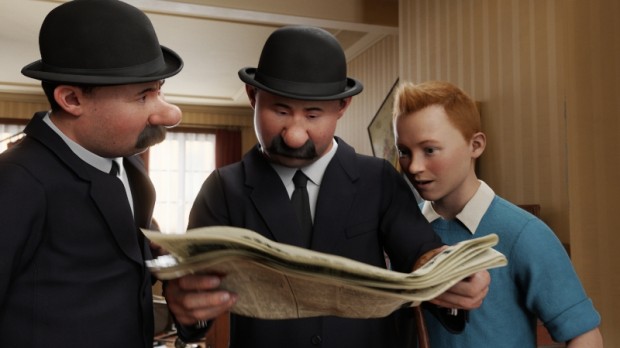
When world-famous reporter Tintin (Jamie Bell) purchases a beautiful model of a 17th-century sailing ship - the Unicorn - he finds himself caught up in the ancient mystery of the actual Unicorn and its captain, Sir Francis Haddock. A man named Sakharine (Daniel Craig) is willing to commit murder to uncover that mystery, and Tintin's quest to beat him to it will lead him on a continent-spanning adventure - accompanied, as always, by his faithful dog Snowy. Along for the ride is the alcoholic Captain Haddock (Andy Serkis), descendant of the Unicorn's original captain and an important key to the mystery; also occasionally turning up to lend a not-very-helpful hand are the dimwitted Scotland Yard detectives Thomson (Nick Frost) and Thompson (Simon Pegg).

Okay, confession time: it's actually been years since I opened the covers of a Tintin comic. I had to check the movie's Wikipedia entry to learn that the storyline is cobbled together from three of the comics: The Crab with the Golden Claws, The Secret of the Unicorn and Red Rackham's Treasure. Which is a logical choice, seeing as it combines Tintin's and Captain Haddock's first meeting with the adventure in which Haddock's background features most prominently. And in knitting together these three issues into a seamless movie plot, Moffat, Wright and Cornish earn their paychecks. As do the army of CGI animators who created the gorgeously detailed locations, and Spielberg for both the fun action scenes and the wholesome, old-fashioned adventure tonality in which they inhabit. It's a fun movie, more fun than anything Spielberg has made in years - and that includes Indiana Jones and the Kingdom of the Crystal Skull.

But it's in pseudo-realistic motion-capture 3D animation. And my dislike for this particular animation style has not abated; in fact, I'm dismayed it picked up another two advocates in Spielberg and Peter Jackson. I've already discussed how it always makes characters look dead-eyed and inexpressive, and that problem is present here - in its titular protagonist, no less. Look at the publicity stills - that dull, slack-jawed look is pretty much permanently affixed to his face. It could be argued that the original comic Tintin is a deliberately blank slate as well, with no distinct personality nor backstory, but Hergé still knew how to draw him with expressions. Hergé's Tintin was never dull, which is what Spielberg's Tintin is. And this isn't an uncanny valley problem, which this movie quite successfully avoids; Haddock and Thomson and Thompson are enjoyably expressive, largely because their features are deliberately cartoonish. This Tintin is dull by design.

This exacerbates another problem when the movie gets to its action scenes. There's a midsection chase scene through a Moroccan city that's superbly well-choreographed, employing a camera that swoops through a single tracking shot in ways that would be impossible in live-action (and must've had Spielberg creaming in his pants). It's thrillingly good fun, and nicely brings Hergé's own wildly slapstick action scenes into the cinematic medium. But there's one part - which can be seen in the trailer - in which Tintin rides a motorcycle off a ledge, it breaks into pieces, leaving him holding the handlebars, which he uses to zipline down a telephone cable in pursuit of a hawk that has stolen the Macguffin. What is he thinking and feeling in this scene? Is he a fearless daredevil who thinks nothing of performing such acrobatic feats? Or is he in absolute terror at the death-brushing predicament he got himself into, as any normal person would be? We don't know. Because we never see his face in this scene.

Compare that to a similarly wild action scene in Cloudy with a Chance of Meatballs, in which the hero free-runs through the flying debris of a tornado, then gives us a moment to show his emotional reaction at, well, having survived a free-run through a tornado. This is important, guys. Knowing what's going through our hero's mind is crucial in the immersive experience of a film, especially so in an action scene. Because otherwise, it's no more than a shallowly spectacular circus act by performers whom we don't know and have no emotional investment in. What's sad is that Spielberg used to know this. That's how he directed the Indiana Jones movies, with a game collaborator in Harrison Ford; his "oh shit oh shit I don't know if this is gonna work" look, his "aaaa nooo we're gonna diiiiee" look, his "enough enough I give up just kill me please" look, and his "okay that is it I have had it this ends right now" look are exactly what made Indy the greatest action hero of all time. And now, Spielberg gives us an action hero who performs feats Indy could never have dreamed of, yet never looks anything more than mildly flustered.

Comparing it to a more cartoony 3D-animated film also raises another problem with this movie, and with the whole pseudo-realistic style as a whole. Namely, is it realistic or not? Are we meant to be seeing a representation of live-action reality, or the deliberately exaggerated slapstick of a cartoon? Insanely over-the-top action sequences like the Morocco chase are fine if it's the latter, but in the former are just unbelievable and phony. This confusion somewhat marred my enjoyment of this and its other action scenes, as thrilling and as well-staged as they are. Even its non-action scenes; some of its jokes and gags, while taken directly from the comics, come off as cheesy and kiddish. Again, they'd be funny if it were made clear we're watching a cartoon (or at least, one in which the main character looked as much like a cartoon as everyone else in the movie), but therein lies the inherent problem of the pseudo-realistic motion-capture animation genre: it's this nebulous, confusing, neither-one-nor-the-other middle between live-action and animation, between realism and heightened realism.

Yeah, I do this a lot - writing ostensibly favourable reviews that spend more pixels on criticising the movie than praising it. And then I wrap it up with a concluding paragraph that says, okay, seriously you guys, it's still a good movie. It's good old-fashioned all-ages fun, and a fair and loving tribute to Hergé's comic creation. But it could've been a lot more - not just a truly brilliant film adaptation of the unequivocally brilliant comics, but a worthy reprise of Raiders of the Lost Ark, to which Spielberg is clearly paying self-homage. Kingdom of the Crystal Skull sorely disappointed me and made me suspect he's losing his touch, but The Adventures of Tintin: The Secret of the Unicorn confirmed it; he's forgotten that one simple thing that made his older movies so genuinely thrilling, instead of superficially so. Oh well. Maybe the sequel - which Peter Jackson is directing - will be better.

NEXT REVIEW: Abuya
Expectations: oooohohoho

Wednesday, August 31, 2011

A model that doesn't live up to its make

Cars 2
My rating:


A good friend and fellow movie buff has described Cars 2 as "the boss' pet project." See, in 2006, Cars was the first film John Lasseter had directed since 1999's Toy Story 2, and this sequel is his only other film in the five years since then. In interviews, Lasseter has talked up his love for the sport of auto racing and the historic U.S. Route 66 highway that inspired the first film. And also, he's the Chief Creative Officer of Pixar, as well as of Walt Disney Animation Studios. So yes, this being the boss' pet project is as good a reason as any for why Pixar chose to make a sequel to one of their least-loved movies; the only other reason is that its least-loved movie is also its most money-making, with merchandise sales in excess of $5 billion. And then the movie came out in June and earned Pixar's worst critical drubbing ever, scoring only 37% on RottenTomatoes. It's enough to make a true-blue Pixar fanboy like myself despair.

Okay, Pixar is still Pixar. But yeah, this is the least Pixar-like Pixar movie since, well, ever.

Lightning McQueen (Owen Wilson) is now a world-famous racer who has returned to his home of Radiator Springs and his closest friends, especially Mater (Larry the Cable Guy). Then they learn of a new race organized by billionaire Sir Miles Axelrod (Eddie Izzard) as a means to promote his new biofuel; provoked by taunts from Italian racer Francesco Bernoulli (John Turturro), McQueen decides to take part, this time bringing Mater with him to the race's international locales such as Japan, Italy and England. But Mater's simple-mindedness and ignorance end up embarrassing him and drives a wedge in their friendship - and in turn, leads to Mater getting embroiled in a deadly spy plot. British intelligence agents Finn McMissile (Michael Caine) and Holley Shiftwell (Emily Mortimer) mistake him for a secret agent, and recruit him into foiling a conspiracy to sabotage the race, conducted by the evil genius Professor Zündapp (Thomas Kretschmann) who is working for a secret mastermind. A conspiracy that may have deadly consequences for the racers - including McQueen.

As you can probably tell, I have a weakness for animated family films. Two of my No. 1 best films of the year have been from Pixar, and I've been mostly quite generous in my opinions of even non-Pixar offerings (except for Despicable Me, and nothing's gonna convince me it was good). Cars 2 is about as good as the more recent DreamWorks Animation releases, which means it's still quite good; it's a bright, imaginative, clever, and perfectly enjoyable movie that will keep kids enthralled and adults entertained. But Pixar's usual, self-ordained standard is to keep both kids and adults enthralled - the former with dazzling visuals, the latter with either thought-provoking ideas or heartrending emotional weight and often both. And their latest film just doesn't match up, largely because it only has one of those to offer.

The first Cars was about humility, maturity, and finding something worth loving more than one's own self. Which, in execution, wasn't quite as engaging as Toy Story 3's ruminations on mortality or Up's meditation on grief and loss, but at least it was about something. Cars 2 is about how Mater should be comfortable being himself - which, okay, is something, but it's also terribly hackneyed and trite. It's a tired old cliché of kids' movies, and it's even been done better in films like How to Train Your Dragon and Cloudy with a Chance of Meatballs. None of the supposedly poignant scenes between McQueen and Mater stir any emotions, and it doesn't help that the "himself" that Mater ought to be is an idiotic redneck stereotype. "Being yourself" is the wrong lesson to learn if you're a buffoon to begin with! Sure, he eventually redeems himself and saves the day with his unique Mater-ness, but that's just Screenwriting 101. Pixar is usually much better at storytelling than this.

Fact is, the friendship between these two wasn't even the most affecting relationship in the first film; that'd be the one between McQueen and Doc Hudson, voiced by the late Paul Newman. Both character and actor get a tribute in an early scene that feels clumsy and tacked-on, and serve only to remind us that Cars, despite being the weakest entry in Pixar's ouevre - till now - was still a characteristically Pixar story. More proof that Cars 2 isn't is the fact that its new characters are all one-note and underdeveloped. Neither Michael Caine nor Emily Mortimer are impressive as Finn McMissile and Holley Shiftwell, mainly because all they do is follow the plot; there's a half-hearted attempt at a romantic subplot between Holley and Mater that's just half-hearted. And Finn's arsenal of gadgets is fun, but for the most part he just plays second fiddle to Mater. For the amount of screentime they have, neither of them possess the depth that Pixar is known for investing in their characters.

But Cars 2 does improve on its predecessor in one respect. In my Retro Review of Cars, I mentioned that it's slow and self-indulgent, but its sequel makes up for that with its action scenes. They're fun, frantic, filled with clever and witty touches, and not to mention frequent; parents needn't worry about the kids getting too bored with the talky bits before the cars start chasing and shooting at each other and blowing things up again. Another thing Pixar is an acknowledged master of is the genuinely thrilling action scene, and on that score this movie delivers. It is also typically great to look at, and moving the story out of Radiator Springs allows it to show us some gorgeous visual design; I thought the Porto Corsa locale of the second race was especially beautiful. We also get to see a lot more of this world of anthropomorphic automobiles - which, yes, doesn't make a lick of sense, but it is what it is: an excuse for lots and lots of car puns, both verbal and visual. Some of them may be groaners, but hey, I like puns.

So once again, it's a fun and enjoyable movie and perfectly serviceable as family entertainment. It just isn't more than perfectly serviceable, which is what we've come to expect from Pixar. And being a fanboy of theirs, I can't help but wonder why they made this, and why they made it like this. Maybe it really is the boss' pet project; maybe Pixar's true legacy is being carried on by folks like Pete Docter, Andrew Stanton and Brad Bird, and maybe Lasseter is losing his touch - which is sad for the man who directed Toy Story and Toy Story 2. Or maybe the real reason is this. Which, if it is true, I'm more than willing to forgive them for. Let them get their moneymaker out of the way, let them silence their shareholders, let them earn the creative freedom they need to make masterpieces once again. Let this just be a minor misstep, or a necessary evil - and not, God forbid, the start of a decline.

NEXT REVIEW: Conan the Barbarian
Expectations: I love this stuff, it can't be that bad - can it?...

Thursday, June 9, 2011

Skadoosh again

Kung Fu Panda 2
My rating:


Apologies for not doing a Retro Review of the original Kung Fu Panda from 2008. I had the DVD all ready, and in fact I rewatched it the night before I went to see this sequel, but other mundane matters intruded; and yes, I am aware I am already behind on the latest cinema releases. (Curse you, day job that pays my bills and puts food on my table!) Anyway, Kung Fu Panda was the first genuinely good DreamWorks Animation film since Shrek seven years prior, and represented a turning point for the studio that had, during those years, earned a reputation as Pixar's punching bag. A funny-talking-animal movie starring Jack Black as a panda that learns kung fu seemed so similar to the rest of DreamWorks' undistinguished, uninspiring output that it was truly surprising how good it actually turned out. The question now is, can they maintain that level of quality and not fall into the trap that befell the Shrek sequels?

Yes they can - even if they can no longer maintain the surprise.

The Dragon Warrior Po (Jack Black) is now the full-fledged protector of the Valley of Peace, friend of the Furious Five - Tigress (Angelina Jolie), Crane (David Cross), Mantis (Seth Rogen), Viper (Lucy Liu) and Monkey (Jackie Chan) - but still the son of noodle restaurateur Ping (James Hong). But even as his Master Shifu (Dustin Hoffman) exhorts him to learn how to achieve "inner peace", a new threat emerges. The peacock Lord Shen (Gary Oldman) has gathered an army of wolves, captained by his Wolf Boss (Danny McBride), with the goal of conquering all of China, and they have a deadly new weapon: gunpowder. Shen is aware of a prophecy, told to him by a soothsayer (Michelle Yeoh), of "a warrior of black and white" who is destined to defeat him, which of course refers to Po - and the history between them leads to disturbing flashbacks for Po that cause him to question his very identity.

I don't agree with the reviews that say Kung Fu Panda 2 is better than the original; I say it's about on par with it. Which, of course, still makes it a pretty great movie. The first one was good because of its clear affection and respect for Chinese culture (I still grin at Chor Gom Prison), its eschewment of the irritating tropes that had become DreamWorks mainstays at that point (pop-culture references, pop hit songs on the soundtrack, etc.), and its commitment to being a proper martial arts movie with legitimately thrilling action scenes. This sequel maintains the first two but falls slightly short on the third; the action is fun and imaginative, but there's nothing as jaw-droppingly awesome as Tai Lung's prison escape here. But it makes up for it with a more emotionally affecting story.

Did I say "emotionally affecting"? Sorry, I meant "shamelessly tear-jerking". It will come as a surprise to absolutely no one that Po is an orphaned member of a tribe of pandas whom Shen exterminated in an attempt to prevent the prophecy from coming true. (The prologue that kicks off the movie pretty much spells this out already.) This leads to flashbacks, both of how Ping found Po as a baby and raised him as his own son, and of how Po survived his village's massacre only because his mother sacrificed herself for him. There is nothing subtle or sophisticated about these scenes, but hot damn they worked, and managed to get cynical and jaded ol' TMBF a little misty-eyed. Baby Po is weapons-grade cute, but the animation, art direction and character design on a whole is so gorgeous that these scenes do achieve genuine poignancy.

Another interesting thing about the first Kung Fu Panda was that it was as much Shifu's story as Po's; the latter's ascension to Dragon Warrior was a redemption of the former's guilt over the failings of his former star pupil. Kung Fu Panda 2 attempts the same thing here with the villain, and gives Shen a characterization that mirrors the protagonist's - the peacock lord also has a traumatic past involving his parents that defines his current identity. It isn't as affecting though, mainly because Shen is the villain - and also a less fearsome one than Tai Lung, being a comedic bad guy rather than seriously scary. I'm less impressed with his peacock fighting style than most viewers seem to be, since the fight scenes move too fast to be able to make out any of the moves.

But I carp too much. It's fun and funny and action-packed from start to finish, and handily achieves everything it aims for. Po is more likable than any character played by Jack Black has a right to be - being merely voiced by him probably has something to do with it. I liked the fact that he's still as much a fanboy as ever, and at one point geeks out over a glorious charge of kungfu masters that he is himself part of. And I especially liked the fact that the storyline nicely balances making him the butt of jokes with making him genuinely heroic and badass; he may be the Dragon Warrior, but he is still a bumbler and none too smart, and the two never seem incongruous. Shifu takes a back seat to the proceedings this time, and the Furious Five are once again played by well-known names who barely get half a dozen lines each. (As does Jean-Claude Van Damme, whom I would have no idea was in this till I checked Wikipedia.)

So no, I don't think this is better than the original, and I don't think it's deeper or more adult as James Berardinelli wrote in his review. But it is, as its predecessor was, a terrifically entertaining animated movie that works as well for adults as well as kids. (Especially for kids; my viewing was packed with 'em, and they had a blast.) The thing about both Kung Fu Panda movies is that they take a premise that could've been kiddified crap, and invest it with enough wit, intelligence and sheer craftsmanship to transcend expectations of a DreamWorks Animation movie called Kung Fu Panda. I mean, seriously, Kung Fu Panda?? Hell yes, Kung Fu Panda - now comprised of two equally great films, with a third almost certainly on the way (as the ending of this one teases). And we'll know to expect great things from it too.

NEXT REVIEW: TBA

Wednesday, March 23, 2011

Don't bring the kids

Rango
My rating:


This is an odd movie. It's not just the first animated film for director Gore Verbinski, he of Pirates of the Caribbean fame, but also for Industrial Light and Magic, which is better known as one of the great SFX houses. Its first teaser trailer was exceedingly weird; followed by a full-length trailer that was more conventional, but not exactly inspiring. Then came glowing reviews from Roger Ebert and James Berardinelli and even a positive one from AV Club, which finally tipped the scale to from "run-of-the-mill animated cartoon from a non-Pixar studio" to "interesting movie I should catch". Still, the fact that it's neither a Pixar nor a DreamWorks production, nor even one helmed by anyone with any experience in animated filmmaking, left me with no idea what to expect.

It's still an odd movie. But an original and entertaining one at that.

A pet chameleon (Johnny Depp) with identity issues gets accidentally stranded in the middle of the Nevada desert. After an encounter with a spiritual pilgrim armadillo (Alfred Molina) and a hungry hawk, he comes upon the run-down desert town of Dirt, populated by a cosmopolitan community of toads, rabbits, mice, and other critters. Thinking to reinvent himself as a Wild West hero, he adopts the name Rango and spins a tall tale that the gullible townsfolk fall for easily. And when he (accidentally) kills the hawk, he is hailed as a hero and appointed sheriff by the Major (Ned Beatty) - although the rancher's daughter Beans (Isla Fisher) remains skeptical. Because what Dirt needs isn't a sheriff, it's water; the town faces a severe water crisis, made worse when a clan of hillbilly moles led by Balthazar (Harry Dean Stanton) steals their last remaining water reserves. Rango sets out to save the town - but when the vicious gunslinger Rattlesnake Jake (Bill Nighy) comes a'callin', he'll find his self-spun heroic reputation doesn't hold water. (And throughout the film, a band of mariachi owls foretell Rango's doom.)

Well, it's definitely not for kids, despite being a 3D-animated cartoon. The character design is your first clue; none of the characters are deliberately "cute", not even the little mouse girl voiced by Abigail Breslin, although they are all beautifully designed and characterized. Your second clue is that it's very much an homage to westerns, a genre that not a lot of kids are familiar with; it's packed with references to dozens of older films, not all of which are even westerns. (I'm told there's a Fear and Loathing in Las Vegas in-joke somewhere in there.) I fear for its commercial prospects - and the harried parents bringing their hyperactive kids to watch this - because I thought it was a lot of fun. For one thing, as I have previously mentioned, I like westerns.

For another, the movie is frequently hilarious. I laughed out loud a good three or four times in this; I don't know what it is about the "western" accent that makes funny dialogue funnier, but it just does. In fact, I'm pretty sure I missed a line or two, and I sorely wished it was in Digital 2D, which affords sharper picture and sound. The humour is often of a slightly more sophisticated sensibility than your average Pixar or DreamWorks effort, though there are still plenty of sight gags - and action scenes, at which Verbinski is an old hand. The standout bit is a canyon chase scene that pays homage to both the Star Wars Death Star trench run and old-fashioned western stagecoach robbery sequences. That one was a lot of fun.

It's just too bad that it's not fun all of the way. The AV Club review is right, its basic plot is terribly formulaic and predictable. And I suspect Verbinski, and his screenwriter John Logan, think their theme of identity is a lot more profound than it really is, which might explain the interminable late second act. This is most likely the point where anyone who still thinks this is a kids' cartoon would get turned off completely; it is surreal and dream-like and culminates in Rango achieving a spiritual epiphany via yet another movie reference that's gonna sail over the heads of anyone who isn't a fan of classic westerns. Oh, and there's a mystery plot (that's a takeoff on Roman Polanski's Chinatown - y'know, that children's classic) that also takes its own sweet time to unfold but doesn't turn out to be particularly clever.

Clearly, Verbinski didn't set out to make a typical family-friendly animated film. The director has rounded up a star-studded cast of character actors, and had them record their lines while acting out the scenes as if it were a live-action film, complete with props and costumes. It looks like they had a ball doing it, and it comes through in their performances. It also helps that the character design doesn't do the thing where they try to mimic the actors' features; thus folks like Isla Fisher and Bill Nighy are practically unrecognizable, and you can just focus on their voices. (And besides the ones I mentioned, there's also Ray Winstone, Stephen Root, Gil Birmingham, and a Timothy Olyphant cameo, and I'm betting you won't recognize any of 'em.)

I'm calling it now: Rango is a cult film in the making. It's too weird and idiosyncratic to make much box-office - especially if Nickelodeon Movies, of all studios, are trying to sell it to kids - but it's that same singular uniqueness that'll inspire the kind of rabid following a cult film gets. One might criticize Verbinski and Logan and co. for being self-indulgent, making what looks like a children's cartoon but most assuredly is not. And one could certainly criticize them for that slow midsection, and for taking their subtext a little too seriously. But one could also commend them for having a wildly original creative vision, sticking to it, and pulling off a movie that succeeds at entertaining just the right kind of audience. Which includes me, so that's what I'm gonna do.

NEXT REVIEW: World Invasion: Battle Los Angeles
Expectations: yes yes, the trailers were cool, but that title

Saturday, December 11, 2010

Another crowning glory for the Disney formula

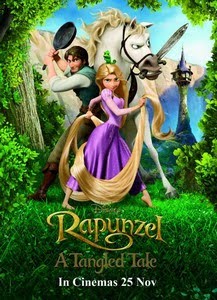
Rapunzel: A Tangled Tale
My rating:


I gave The Princess and the Frog 4 stars, but rereading what I wrote a year ago, I find the tone of my review incongruously lukewarm. Did I over-rate it, or was I too harsh on it once the time came to sit butt on chair and pound out another review? Hmm, 'tis a quandary. In any case, here is the next Walt Disney animated movie - their 50th, incidentally - and it is in many ways as much a return to the old-school Disney formula as the last one. Spunky heroine, cute animal sidekicks, dashing hero, romance, songs, scary villain, and all based on yet another classic fairy tale. Didn't I say a year ago that I had doubts how much more could be wrung out of this same old same old?

O me of little faith. I never should've doubted Disney - not now that they have John Lasseter at their helm.

A baby girl with beautiful golden hair was born to a king and queen. Her hair had the magical ability to heal all illnesses - and so a witch named Mother Gothel (Donna Murphy) kidnapped her, craving her youth-giving magic. The girl, now named Rapunzel (Mandy Moore), grew up believing that Gothel is her mother and has lived in a lonely tower all her life, with no friends except a pet chameleon named Pascal. About to turn 18, she yearns to leave her home-cum-prison, and one day her chance arrives in the form of a thief and rogue named Flynn Rider (Zachary Levi). She strikes a bargain with him to be her guide to the outside world, not knowing that he is wanted by the kingdom's palace guard - and a palace guard horse named Maximus - as well as the Stabbington Brothers (Ron Perlman), his cohorts in crime. And Gothel herself is not about to let her golden-haired goose get away.

It's even more formulaically Disney than The Princess and the Frog. That one at least took place in a more-or-less real-world period New Orleans, and had an ordinary working-class heroine. This one has an actual princess of a generic nameless fairytale kingdom, the kind that films like Enchanted and the Shrek series had a field day parodying; yet it all seems comforting and familiar instead of tired and clichéd. And it's funny, thrilling, heartwarming, poignant, beautifully animated, and terrifically entertaining - everything a Disney animated film should be and has always been.

It does do a couple of new things with the formula though. Chief amongst them is its updating of the Rapunzel story and making it about a domineering mother and an overprotected daughter - which is an obvious approach for a story about a girl who's lived her entire life locked up in a tower. A lot of the Rapunzel-Gothel scenes are uncomfortably close to real-life accounts of child abuse; you get the impression that Gothel's emotional manipulation and passive-aggressive putdowns are things that many a young girl has received from her mother. Perhaps the movie oversimplifies the issue by turning Gothel into an irredeemable villain who thoroughly deserves her eventual comeuppance - but she was a uniquely, deliciously twisted villain while it lasted.

And then there are the numerous little jokes that seem to poke fun at the formula. Am I the only one who thinks the "I've Got a Dream" song sequence is a parody of the typical "I want" song found in pretty much every single Disney animated film? Yes, there's an "I want" song in this one too ("When Will My Life Begin"), as well as a villain song and a falling-in-love song, but if the movie doesn't subvert clichés, as least it makes efforts to cleverly hang lampshades on them. It's also neat that its hero is a none-too-goody Han Solo-type rogue instead of a bland prince, and that its cute animal sidekicks have personalities on top of just being cute. (And funny. Both Pascal and Maximus get some killer gags.)

But what makes it better than even The Princess and the Frog - which it is, even though they share the same 4-star rating - is how emotionally affecting it is. Halfway through I was beginning to think the Rapunzel-Flynn romance isn't going anywhere, and that they'd have to resort to a montage (an easy shortcut for, well, basically anything) or something. Then the ending came around, and damned if I didn't get more than a little teary-eyed. I think it's because the characters are so well-established, that even if their relationships are broad and formulaic, it still works. Rapunzel is recognizably a teenage girl - gawky, excitable, and full of wonder at being able to finally explore the outside world. I'd put her up there amongst the most lovable of the Disney heroines.

Did you know this is the 2nd most expensive film ever made? It cost $260 million, but every dollar is up there in stunning visual design and animation. And it looks like the gamble paid off; it did very well at the box office even against Harry Potter. I was sorry to hear that The Princess and the Frog was financially disappointing, and that this film was radically reworked because of that. Hence the puzzling title (which gives the impression that it's meant to kick off a whole Rapunzel film franchise) - in the U.S. it's called Tangled, to make it sound less girly. No matter. They can market their movies however they like, as long as they keep making 'em - although sadly, they have announced that this will be the last of their fairy tale-based films. They needn't worry. The formula still works.

NEXT REVIEW: Ngangkung
Expectations: Shaheizy Sam FTW?