Showing posts with label Hong Kong/China/Taiwan. Show all posts

Tuesday, May 1, 2012

Such pretty pretty flowers

The Flowers of War
My rating:


I sometimes worry about my credibility as a film critic. Almost all the movies I review are multiplex blockbuster fare (or crappy local films); I hardly ever watch any more, um, substantial stuff. I have a pretty big pile of unwatched DVDs that include highly-acclaimed and award-winning titles from years ago. In my defense, the local cinema releases keep me busy enough, and I certainly catch any critically buzzed-about film that actually gets released here as much as I can. Which brings us to The Flowers of War, Zhang Yimou's magnum opus set during the Rape of Nanjing, and China's entry for Best Foreign Language Film at the last Academy Awards - although it didn't make the shortlist. But a Zhang Yimou film starring Christian Bale, making it the closest thing to a Hollywood Zhang Yimou film? I couldn't miss it.

Besides, most Chinese audiences will probably think it's a very important film. An oh so very very important film.

It is the Second Sino-Japanese War, and the city of Nanjing has just fallen to the invading Japanese army. An American mortician named John Miller (Christian Bale) heads through the ruined city towards the Winchester Cathedral, where he has been contracted to bury the head priest - but the church is only manned by a boy named George Chen (Huang Tianyuan) who tells him there is no money to pay him, as well as a group of Catholic convent girls hiding out from the Japanese. And shortly afterwards, they are joined by a gaggle of prostitutes from the city's red-light district - also, Major Li (Tong Dawei), a lone surviving Chinese soldier, holes up outside to prepare an almost-certainly-hopeless defense. At first, the drunken Miller wants nothing to do with the refugees, even though one student named Shu (Zhang Xinyi) has a crush on him, and the de facto leader of the prostitutes, Yu Mo (Ni Ni) attempts to seduce him into helping them flee the city. But when the Japanese break through and threaten the girls with brutal rape and murder, Miller is finally moved into heroism - even as an entire army bent on ravaging their city stands between them and safety.

In the aforementioned big pile of unwatched DVDs is City of Life and Death, which I had picked up on the strength of LoveHKFilm's and McGarmott's reviews. No, I still haven't watched it - but from both their reviews, I expect it's the better film about the Rape of Nanjing. A lot of what's been written about it sounds like it does a lot of things right where The Flowers of War went wrong. But first, let me reassure you that this is not a bad movie. Zhang Yimou does not make bad movies (even though he does not always achieve the greatness he aims for, as in this case). This is a beautifully mounted production, clearly costing lots of renminbi and looks like it was worth every yuan. Zhang is an exacting filmmaker, and gorgeous, precisely-composed shots clearly have the stamp of the man who directed Hero. The man clearly knows how to make an effectively manipulative melodrama; it is never not a compelling watch, and many scenes evoke the strong emotions Zhang is going for.

The problem is that this is a film about the Rape of Nanjing. One of the most horrifying atrocities in recent history, and still a highly emotionally-charged subject for every living Chinese. "Beautiful" and "gorgeous" are not exactly appropriate words for it - yet this is the approach Zhang took. I knew the film was suspect in the opening scenes, when we saw the last-ditch defense by the ragged remnants of the Chinese garrison against the invading Japanese. It was an effectively choreographed action scene, but I kept wondering why we were spending so much time on this when the movie's supposed to be about a group of refugees in a church. There's also a subplot involving the prostitutes who supposedly worked at a red light district with a thousand-year-old history, which the film wanted to romanticise while at the same time allowing the prostitutes to perform a heroic sacrifice that both affirms and redeems their ancient traditions. This we know because they say so, in just so many highly on-the-nose words - but more puzzling than that is a weird fantasy sequence in which they sashay down the church aisle in slow motion while a disco ball glitters above them.

It's a somewhat stylised film, is what I'm trying to say, and the stylisation tends to undercut the gravity of the real-life horrors that it means to depict. And even when it's not resorting to slow-mo or fantasy sequences or carefully-composed explosions of colours, it tends to play everything too broadly. The students all cry and scream hysterically, and although you can't quite expect 13-year-old girls to be stoic when facing gang-rape, their histrionics gets a bit much. On the other hand, the prostitutes (the ones not named Yu Mo, that is) bitch and whine constantly about their jewellery, their er hu strings, their pet cat, and other trivialities that they stupidly put themselves in danger for. This brings us to the rape scene - because you can't make a movie about this historical event without showing that - which is one of the most disturbing things I've ever seen on the big screen. It's a grisly fate for a character whom the film allows us to get to know (I'm hiding her identity for fear of spoilers, but really, once she leaves the safety of the cathedral, there's a horrible inevitability to what awaits her).

The end result is that you're horrified at the movie, not at the actual historical Rape of Nanjing; instead of feeling the weight of the real-life tragedy that happened just 55 years ago, you walk out just feeling nonplussed about what you saw. Or rather, I did - perhaps the primarily Chinese audience with me was all "Every Chinese must watch this! We must never forget what happened to our people! Oh the inhumanity!" I'm guessing the film worked great with them, which is why I'm giving it 3-½ stars. Me, I think the subject matter warranted a more restrained approach. Zhang has been accused of propaganda, which I can see; you'll not find a more cackingly, demonically evil bunch of villains than the Japanese soldiers in this movie, and not even the appearance of the seemingly more honourable Colonel Hasegawa (Atsuro Watabe) will mitigate that portrayal. What I thought was more apparent is that Zhang is guilty of exploitation. Not for the purpose of titillation - that would've been unforgivable - but exploitation of the horrors of the events to manipulate our emotions.

Oh, and I haven't even mentioned Christian Bale. His performance is expectedly fine, but his very presence raises the question Roger Ebert brought up: why does this story need a white person to be our viewpoint character? The answer is that this is a China production intended to be China's entry to the Oscars; the powers-that-be want to sell Chinese culture to the West, and Zhang Yimou is their pitchman. And while a film about a recent historical atrocity ought to make for a worthwhile product, the ends appear to have unduly influenced the means. It's trying too hard. (And I could've told them the typically overblown Asian style of melodrama doesn't really fly with Western audiences.) Still, flaws and all, it's a worthwhile watch, if you can stomach a really unpleasant rape/murder scene. And Ni Ni's big screen debut is pretty amazing as Yu Mo, the most seductive of the prostitutes. (The rest of whom, like the schoolgirls not named Shu, get barely any characterisation aside from misplaced priorities in a time of war.) The white guy even gets to sleep with her, so there's that too.

NEXT REVIEW: Battleship
Expectations: big, loud and dumb - question is, how dumb?

Tuesday, January 17, 2012

Flying blobs of blurry CGI

Flying Swords of Dragon Gate
My rating:


I seem to be alone in my indifference to Tsui Hark's previous film, Detective Dee and the Mystery of the Phantom Flame. Folks like Roger Ebert and Noel Murray of AV Club have given it glowing reviews, and though you could chalk that up to gweilos' unfamiliarity with - and therefore lower standards for - Asian martial arts movies, it also made a ton of money in Hong Kong. But there's simply no denying that Tsui made some of the greatest Hong Kong films of all time, including quite a few personal favourites. This, plus Kozo of LoveHKFilm's positive review, finally convinced me to check out Flying Swords of Dragon Gate, a sort-of-sequel-cum-reimagining of his own 1992 Dragon Inn, and maybe give the new Tsui Hark - as opposed to '80s-and-'90s Tsui Hark - another chance.

It's better than Detective Dee. But like that movie, it's still a mess.

The thoroughly corrupt East and West Bureaus, given carte blanche powers by the Emperor, rule Ming Dynasty China with an iron grip. But Zhao Huai'an (Jet Li) opposes them, and has just crippled the West Bureau by taking out its leader (Gordon Liu). But the head of the East Bureau, the eunuch Yu Huatian (Aloys Chen), is a much more cunning opponent - however, he has his hands full tracking down a runaway palace maid named Su Huirong (Mavis Fan) who may be pregnant with the Emperor's illegitimate child. Huirong is rescued and aided by a masked female warrior (Zhou Xun) - who has also adopted the name Zhao Huai'an - and taken to the Dragon Inn, a "black inn" at the edge of the desert and frequented by various criminals and lowlifes. But whilst there, they must hide from the West Bureau men hunting them, led by their Deputy Chief (Sheng Chien), who cross swords with a band of Tartar bandits led by Princess Buludu (Guey Lun-Mei) who are also shacking up there. And then a travelling warrior named Gu Shaotang (Li Yuchun) arrives to add even more fuel to the fire - especially when her companion, a goofy non-fighter named Wind Blade (Aloys Chen), is a dead ringer for Yu Huatian. It turns out some of these folks are searching for a lost, treasure-filled city hidden under the desert sands - plus, there's a sandstorm of Biblical proportions heading their way.

LoveHKFilm probably put it best: this is a throwback to the wild, freewheeling, purely fun Hong Kong period kungfu movies of the '90s, a trend that Tsui himself probably created single-handedly. I have no particular love for films of this sort, although I reckon I can enjoy one if it's really good. This isn't. There are fun parts, but there's just too much of Tsui's kitchen-sink approach (that also spoiled Detective Dee) to coalesce into a proper movie - or even a proper narrative. There's two characters going by the same name, both of whom have a shared tragic backstory; there's a damsel in distress that at least one of them is trying to rescue (or is she? And why?); then there's the inn which has a penchant for serving human flesh, and there's more than a fair bit of casual cannibalism here; then there's a new faction of dubious morality that lock horns with the established antagonists; then another two characters of mysterious intentions arrive at the inn, one of whom introduces the wacky face double hijinks. All this before even the lost city.

Yes, it's all a great big mess; albeit an entertaining one, but only fitfully so. Kungfu films of the '90s showcased spectacular fight scenes, even if they were usually of the wire-fu variety - but the artificial, CGI-laden ones here will make a martial arts aficionado long for the good old days of wire-fu. They're dull, and the cartoony jumping-and-flying CGI figures are more likely to evoke laughs rather than thrills. (Tsui hired the SFX supervisor of Avatar for this film, and to be fair, the environmental vistas are pretty good - the human figures, not so much.) Maybe because it was filmed in 3D - which is, as usual, not the format I watched it in - in which case it appears Tsui's approach to making a 3D kungfu film is to lose all the stunning athleticism and intricate choreography of martial arts. Or you could point the blame at the cast, of whom only Jet Li - and maybe some of the minor baddies - have any kungfu background.

But then again, neither did folks like Maggie Cheung, Brigitte Lin, Anita Mui and Leslie Cheung, all of whom looked fine playing various wuxia badasses in their heyday. It's just as likely that the current crop of pan-Chinese stars simply lack the magnetic screen presence of their predecessors, even if Zhou Xun can do fine in roles that don't call for her to kick ass. But that doesn't explain why Jet Li is practically phoning it in. And it doesn't explain why the characters are so thin, the typical wuxia themes of honour, righteousness and love they play out so half-baked they might as well have not been in there. It may have been because of the dubbing, which makes everyone sound stiff and stilted even though the version I watched was in Mandarin and most of the cast are mainland Chinese.

To be fair, Guey Lun-Mei seems to be having a hell of a good time playing Lusty Exotic Warrior Princess. And the other good performance is a dual one from Aloys Chen, who plays both the prissy eunuch villain and the doofus amongst kungfu warriors with no kungfu skills of his own and makes them both instantly distinctive. Around the halfway mark, the various characters coalesce into two opposing factions, and although the good guys don't entirely trust each other, at least it's not as confusing to keep track of who's where and wants what. Some of the plotting is quite clever, especially the ingenious scheme to break the everyone-stuck-in-the-inn-and-wanting-to-kill-each-other stalemate. As messy as it is, it's never boring or tiresome.

So yes, it's an improvement over Detective Dee, and I'm hopeful it'll herald even better movies from Tsui. Maybe it's just taking him a while to get back into his '90s groove. I think he's still got it; he just needs to get better adjusted to the changes in the Chinese film industry over the past quarter-century. Like CGI. And actors inexperienced at the kind of larger-than-life scenery-chewing roles that his brand of wuxia demands. And his own lack of practice at making that same kind of movie for which he became famous. On behalf of Hong Kong movie fans everywhere, I sure hope he's still got it.

NEXT REVIEW: Relationship Status
Expectations: cautiously optimistic

Monday, December 5, 2011

You never forget the first apple of your eye

You Are the Apple of My Eye
My rating:


I wasn't sure if I wanted to watch this, or having watched it, review it. Owing to my slow reviewing rate, I've had to miss out on a lot of movies lately (Immortals, Happy Feet 2, Puss in Boots), and I still have a ways to go before I can catch up to the latest releases. And Chinese-language films are a low priority for me - but three things kept nagging me to watch You Are the Apple of my Eye: LoveHKFilm's review, glowing comments from the Lowyat.net crowd, and the fact that tickets are still selling out almost a month after its release. (Oh, and also because that similarly-named Stevie Wonder song keeps getting stuck in my head.)

I'm glad I did. But while local Chinese teenagers may think this the best movie of the year, my response is a little more muted.

It is 1994, and Ko Ching-Teng (Ko Chen-Tung) is 16 and a senior in high school. All his best friends - Boner (Yen Sheng-Yu), Ah Ho (Hao Shao-Wen), Cock (Ao-Chuan) and Groin (Tsai Chang-Hsien) - have a crush on the class top student Shen Chia-Yi (Michelle Chen), but Ko-Teng has little interest in pursuing girls. Until one day he is caught in an, um, indiscretion, and the principal assigns Chia-Yi to "keep an eye on him". She decides to help him with his studies, and thus begins a friendship amongst her, the boys, and her best friend Hu Chia-Wei (Wan Wan) that lasts through high school, college and adulthood. And through the years, Ko-Teng and Chia-Yi dance around their feelings for each other, that change as they both mature.

I'm not a big anime fan, but one anime series I unreservedly love is Azumanga Daioh. It's about the everyday lives of a group of highschool girls (and lemme tellya, it ain't easy for a grown man to admit to liking a show about that), and aside from being side-splittingly hilarious, it's also a gorgeously nostalgic look at the simple and so much more innocent days of school. I mention this because You Are the Apple of My Eye evokes the same nostalgia, when studying, exam results, classroom pranks, hanging out after school, and teenage crushes were all you had to worry about. It's also frequently very funny, and its humour of a particularly crude nature owing to the fact that these are a bunch of horny teenage boys. The indiscretion Ko-Teng is caught for is a synchronized masturbation act with Boner in the middle of class, which now that I think of it, is a stunt that one or two reprobates from my own school might well have pulled off. (Heh heh, pun totally intended.)

But that's just the first half of the movie. The second follows Ko-Teng after the group splits up to different universities and he and Chia-Yi keep up a long-distance never-quite-romantic relationship, and this part tends to drag. For one thing, it spends more time on Ko-Teng's quirky uni roommates (that aren't as likable as his highschool buddies) than on how the central romance progresses. For another, the progression of the central romance isn't very interesting. It isn't very clear how they both mature and drift apart, and the interlude about Ko-Teng organising an underground fight tournament feels like a totally different movie. Also, it glosses over the other boys' equally heartfelt feelings for Chia-Yi. For all that it's adept at creating individually touching moments - e.g. the phone conversation between Ko-Teng and Chia-Yi on the night of the 921 earthquake, gorgeously lit by moonlight - its insights are really kinda shallow.

Which is a characteristic of how Asian movies and TV dramas handle romance as a whole. I've often mentioned how the biggest difference between Asian and western film is that the former is never afraid to go for shameless melodrama, and I've also mentioned how this works on me just fine - when done well. You Are the Apple of My Eye does it pretty damn good, and it helps a lot that it aims for bittersweetness rather than overblown cornball. But it isn't immune to the weakness of substituting sentimentality for real depth. It also portrays a very Asian approach to love and romance, in which the male is expected to "confess" his feelings for the girl and "pursue" her until she "accepts" him - and let's face it, that's an annoyingly juvenile way to go about it. Part of the reason why the second half drags is that you'd expect Ko-Teng to man up and just tell Chia-Yi how he feels about her, but he still can't bring himself to even admit that spending a day together is a "date".

But hey, I suppose that's how it's really like for lovestruck Taiwanese teenagers. And I suppose that's how it really happened for Giddens, the blogger-turned-novelist-turned-first-time-director who is adapting his own autobiographical novel. Giddens is a pop culture phenomenon in Taiwan - as is Wan Wan, a popular webcomic artist who plays a fictionalised teenage version of herself here - and both may account for the movie's record-breaking box office over there. But he's really quite good for a fledgling director, employing flashy CGI visual gags with panache yet proving equally capable at the quiet emotional moments. And he found the perfect two actors to play both his cinematic self and his teenage first love. The coincidentally-named Ko Chen-Tung has terrific screen presence, and Michelle Chen is luminous in just that exact girl-next-door high-school-first-love kind of way. Boys and girls alike will fall head over heels for one or the other of them in droves.

While the broad strokes of the storyline succeeds at tugging the heartstrings, it's a pity that a movie that spans a 10-year unrequited romance doesn't quite have as mature a viewpoint as you'd expect it to. But I'll be honest here: teenage TMBF was as much a besotted fool over one girl or another as Giddens/Ko-Teng, and You Are the Apple of My Eye did a marvelous job of taking me back to those days. In fact, I considered giving it 4 stars, if only because it gave me that rare feeling of being so charming and enjoyable that I didn't want the movie to end. Which, yes, is rare. (By the way, you might want to watch this on DVD instead of in cinemas. The Censorship Board has been at work here, snipping off some of the more off-colour jokes as well as the bits where Ko-Teng walks around his house stark naked. Fortunately, one hilarious bit involving the English F-word is intact, and is guaranteed to bring the house down.)

NEXT REVIEW: Misteri Jalan Lama
Expectations: yay Afdlin Shauki doing... fantasy?

Thursday, August 4, 2011

A History of Violence: China, 1917

Wu Xia
My rating:


TMBF is now taking suggestions for good online sources for reviews of Chinese and other Asian films in English. As you may have noticed, I rely a lot on LoveHKFilm, but their updates can be spotty; they sometimes don't post up a review of a major Hong Kong release till long after its initial release. Thing is, I don't know any other good Hong Kong movie review site (in English, please), so if you do, please share. I know a few that aren't very good, whose reviews are nowhere as witty and sharp as Kozo's (LoveHKFilm's webmaster) and his crew. Their stuff is always fun to read, which to me is reason enough to check out a film they recommend. Although I don't always concur with their opinions - Kozo liked Detective Dee a lot more than I did, for one.

But this one - this one is good.

Liu Jinxi (Donnie Yen) is a humble paper maker in the remote village of Liu, living with his wife Ayu (Tang Wei) and two sons. His idyllic life is interrupted when two bandits attempt to rob the village's general store while he's in it, and he fights them off and kills them through sheer dumb luck - or so it seems. Detective Xu Baijiu (Takeshi Kaneshiro) believes there's more to Liu than meets the eye, and believes him to be a master martial artist of immensely deadly skill - although he has trouble proving it. But soon, members of the evil 72 Demons clan - including a vicious female warrior (Kara Hui) as well as the clan's own Master (Jimmy Wang Yu) - descend upon the helpless village in search of a lost scion.

It takes a certain hubris to name your film after its genre; as if you intend your movie to be a definitive statement on the entire genre. We've already seen one such Hong Kong movie early this year, and I didn't much like it. This one is clearly much better, but its title is a puzzler; it's not at all a classic wuxia film, it's a fresh and somewhat postmodern take on it. Now, it's not impossible for a film to be both a fresh look at a genre and a definitive entry; in wuxia alone, Crouching Tiger, Hidden Dragon comes to mind, and there's also Sergio Leone's spaghetti westerns. But director Peter Ho-Sun Chan's Wu Xia is more like the Unforgiven of wuxia movies.

First, the CSI element. Yes, Xu's investigation into Liu involves a CSI-ish recreation of how he really killed the two bandits, based on forensic evidence gathered from the crime scene. It's quite cool, and involves a creatively realized scene in which Xu imagines the fight taking place while he observes nonchalantly. And his version of forensic science is the traditional Chinese medicine version, involving kooky ideas of chi and pressure points and acupuncture. (Yes, I'm calling them kooky. Apologies to TCM believers, but Western science is my God.) I certainly haven't seen anything like it in a wuxia film, and it's both unconventional and enjoyable.

But what's even more unconventional is how the film depicts the wuxia world. There are precisely zero heroic knight-errants here; every skilled martial arts practitioner in this story is a vicious criminal bordering on psychotic serial killer - or in the case of Liu, a former one. Yes, the premise is exactly that of A History of Violence, and Liu's former compatriots are portrayed as the same kind of inhuman monsters as the Irish mob in David Cronenberg's 2005 film. And since every other character in this story is either a simple peasant or a civil servant with no kungfu skills to speak of, this is a rather damning portrayal of the "jiang hu" that's so frequently romanticised in the genre. (It's also what raises the comparison with Unforgiven.)

All this is cool and interesting, but what makes it genuinely good is some solid storytelling craft and filmmaking flair. I'm reminded once again how utterly gorgeous Chinese period movies can be; the village of Liu is a flawlessly recreated location, and beautifully filmed in an opening scene that shows us the idyllic lifestyle of Liu and his fellow villagers. Chan's camera can be flashy, but always knows what it's doing; he shifts between quiet drama, understated suspense, and high-flying action thrills with remarkable self-assurance. There's a bravura scene set at dusk in a deserted forest trail, in which the tension is as heart-stoppingly thick as any horror movie, and makes you believe for a brief second that Liu could actually be a criminally insane murderer.

Which brings us to the acting, because Donnie Yen's performance in that scene is half of what makes it so terrific. This is probably the best entry in his resume to date, just for all the different sides to Liu that he plays; loving husband and father, simple village doofus, cold-blooded killer, reluctant badass, and Zen-calm philosopher. All this from Donnie Yen, folks, who of course delivers on the kungfu-fighting front as well. In fact, Chan and his screenwriters Aubrey Lam and Joyce Chan take care to develop all the characters; Xu values the letter of the law above basic human empathy, and even Ayu has a scene that explores what she's going through ('cos if you have Tang Wei in your cast, it'd be a shame not to use her talents). Even the villains get welcome shades of dimension, and the cast are all up to the task of portraying them.

Curiously, this is my second 4-star film in a row with a somewhat disappointing ending. Wu Xia's is something of a deus ex machina, which I'm willing to forgive more than an abrupt ending that leaves loose ends hanging. But like Hanna, the greatness of what came before still makes this one great. I hasten to add that it's not really a full-on kungfu action movie; the action scenes are satisfying but few and far between, and it spends most of its running time switching between character drama and suspense thriller. But it is very good at all of these things. Thank you LoveHKFilm, your recommendation (this time!) is spot on! Let's hope there'll be more good ones from Hong Kong, and let's hope you guys let me know in time to catch them.

NEXT REVIEW: Captain America: The First Avenger (sorry, looks like I couldn't make it for Senario the Movie: Ops Pocot)
Expectations: sounds like it's quite different from Thor

Tuesday, May 31, 2011

...right over my head

Let the Bullets Fly
My rating:


It's been a while since I reviewed a Chinese-language film (aside from two local productions). There just hasn't been anything from Hong Kong recently that caught my eye; on top of that, my favourite source for Hong Kong and other Pan-Asian film reviews has slowed down a lot recently, depriving me of information on Asian films worth looking out for. But Let the Bullets Fly was one that got a glowing review from LoveHKFilm. And it's finally here on Malaysian shores, but only through the GSC International Screens program, and showing only in three cinemas. I'm quite worried that it's on a limited run and will disappear from our screens before long, hence my decision to bump it up on my already-backlogged reviewing schedule. (Nur Kasih: The Movie and Kung Fu Panda 2 will just have to wait.)

And it is so very much worth it. But I have to admit, I almost gave up on writing this review.

In 1920s China, in the remote Sichuanese countryside, a bandit leader (Jiang Wen) robs a train carrying Ma Bangde (Ge You) and his wife (Carina Lau), on their way to the backwater Goose Town to take up the governor post. But Ma is actually a conman who buys gubernatorial posts to bilk the locals out of tax money - and he poses as his own (dead) counselor Tang to save his own skin from the bandits. The bandit leader meanwhile, decides to pose as Ma and play the con himself, and they all ride into Goose Town - which is controlled by local gangster Huang Silang (Chow Yun-Fat). Ma/Tang knows the game is to kowtow to the gangs and walk away with the money, but the bandit leader/Ma kneels to nobody, certainly not a murderous tyrant like Huang. And thus the stage is set for a battle of wits, wordplay, and whether or not the bandit leader/Ma is actually the fearsome "Pocky" Zhang whom even Huang fears... or does he?

Wow. This film is dazzling. Its title may lead you to expect a John Woo-style balls-out action movie, but it's actually... um, to be honest, it's hard to peg it into any particular genre. It's very funny, but its humour is of the pitch-black variety, in which blood gets spilled and spattered and it's meant to make us laugh (albeit uncomfortably). Zhang/Ma and Huang - with Ma/Tang possibly double-crossing and triple-crossing them both - do battle through cunning and trickery more than with guns, although when the bullets do fly, the action is fast and frenetic (and Zhang/Ma's bandit cohorts are totally badass). There are clear homages to Westerns, with its premise of a man riding into town and cleaning it up, but possibly befouling it a little bit more first. But whatever genre fields it plays in, it is always and ineluctably its own singular and terrifically unique creation - one that takes you for a ride through places you've never been.

Half of which whizzed by me so fast that I could barely keep up. Which brings me to why I almost made this my second ever non-review; it's an extremely dense and complicated plot, involving people lying to each other, knowing that they're lying, and knowing that they know that they're lying. It's also an extremely fast-moving plot, in which everything can turn on a single line of rapid-fire dialogue. And the dialogue is rich in Mandarin wordplay and Chinese cultural references, almost all of which flew over this shameful Chinese banana's head. (The English subtitles do a valiant job, but more than one instance the largely-Chinese audience laughed at something that sounded perfectly innocuous in English.) And there's supposedly a fair bit of pointed satire in this movie, which I again missed because I am somewhat behind on my grasp of the current political scene in China.

Which means this is going to be a pretty lame review. If I'm going to review a film well, it is imperative that I actually understand it; my mantra as a film critic is to engage a movie on its own terms, and judge it by how well it accomplishes what it aims for. Watching Let the Bullets Fly often made me feel like a bystander listening in on a conversation between an extremely intelligent and witty speaker and several enraptured listeners content to laugh at all his jokes. Another reason why I'm finding it hard to review this film is that it's also extremely unpredictable; as is the nature of black comedies, it's hard to pick a side to root for at first, since none of the three main characters are particularly admirable folks. I said at first, since eventually a clear protagonist (who is not above doing some pretty reprehensible things) and antagonist (who still adheres to his own code of honour) emerges.

But it was fun. Unpredictability at the movies is such a rare and precious thing; seriously, when was the last time you watched a film in which you honestly could not tell what was going to happen next, or how it would all end? A lot of the comedy was broad enough that it did translate well, or at least well enough to earn a laugh from me; one especially LOLworthy moment was when the bandit leader attempted a little acting, having previously been pegged as a lousy actor. All three main actors are terrific; Jiang Wen was super cool, Ge You was a total weasel yet strangely endearing, and Chow Yun-Fat gets to ham it up as both the gentlemanly gangster and his idiot double. (Yes, Huang has a double, and Chow is clearly having a ball playing him.) There's also solid support from Carina Lau as an unrepentant gold-digger, the band of young hunks who play the rest of the bandit gang, and Zhou Yun as the sweetly innocent prostitute who tames these men's hearts.

However, the real star of the show is Jiang - his direction, to be precise. Here is a director in absolute and consummate control of his film, right down to the occasionally fake-looking CGI which wouldn't surprise me if it was meant to be cheesy. Every stylized shot, every whip-pan, every lightning-quick edit, every line delivery is masterfully precise - and that extends to every plot twist, every Mandarin joke, and every subversive little jab that snuck past China's censors. I may not have gotten all (or even most) of it, but I do know I'll be getting this movie on DVD and taking my time to savour it. I reserve the right to revise my rating upward and giving it a high spot on my year-end list of 2011's best films. Even now, I'm already thinking it deserves 4-½ stars.

NEXT REVIEW: Nur Kasih: The Movie
Expectations: yay Kabir Bhatia!

Tuesday, February 8, 2011

A very un-Buddhist movie

Shaolin
My rating:


Is it just me, or is this film being pretty damn ballsy calling itself Shaolin? As if it aims to be the definitive movie about Shaolin monks, their temple's storied history, their Buddhist philosophies as well as their martial arts. Which is a huge thing to tackle, more so than even, say, the definitive ninja movie. It's certainly got the budget and the prestige, being the biggest Hong Kong release this CNY (that isn't a star-studded comedy that I don't intend to watch because it'll have dozens of in-jokes about HK life and movies that I also didn't watch).

And yes, it's also got the ambition - but a very misguided one.

It is the Warlord era of pre-Republican China, when the common people suffered under the endless wars between the power-hungry, and only the compassionate Shaolin monks offered succour. One of these warlords is the arrogant Hou Jie (Andy Lau), who has conquered the city of Dengfeng and murdered its former commander at the very steps of the Shaolin temple. But the tables are turned when his own second-in-command Tsao Man (Nicolas Tse) betrays him and attempts to murder him and his family. They find themselves seeking refuge at the same Shaolin temple - but his daughter dies, and his wife (Fan Bingbing) abandons him. Now a broken and humbled man, Hou Jie stays at the temple and becomes an initiate, apprenticed to cook Wudao (Jackie Chan), studying Shaolin kungfu under its senior brother (Wu Jing) and Buddhist philosophy under its abbott (Yu Hai). But Tsao Man's depredations upon Dengfeng grow worse - and it isn't long before he learns where Hou Jie is hiding.

I'm basically pretty much non-religious, but my parents are Buddhist, and I sat through many a dinner table discourse on its tenets while young. So I knows me a thing or three about Buddhism. If there is one word that best describes the entire religion, it would be moderation; hence the reason why Buddha's teachings are often called "the middle path". I mention this because Shaolin, the film named after the most cinematically famous disciples of said religion, is a very immoderate film. It is cheesy. It is shamelessly manipulative. It is waaaayy over-the-top melodramatic and heavy-handed. And it looks like it cost an extravagant bucketload of yuan.

This is a graceless, artless, 200-pound anvil of a movie in which nothing that happens isn't immediately predictable within the first 20 minutes. When Hou Jie says to his protegé, "strike when you have the upper hand, or it will be you who will end up dead," you know Tsao Man will ironically echo the same words to him later. When Hou Jie defaces the temple's signboard in the beginning, you know he will shamefully wash it off later. When he rejects a British officer's proposal to build a railroad through his territory, you know the filthy traitor Tsao Man will take that same offer and sell out his country's interests. (And then run a side trade peddling historical treasures to the same officer, 'cos hey, why not?)

There is absolutely no string this movie won't pull in persuading you that 1) Hou Jie was an ass, 2) but then he totally found enlightenment and became good, 3) Tsao Man is an ass, 4) the Chinese peasantry are totally innocent and totally suffering, 5) white people are evil, 6) the Shaolin temple is a totally awesome place and Shaolin monks are totally awesome dudes. Not that there's anything wrong with any of this - but again, it's done with so little grace or subtlety that it becomes tiresome. It is ridiculously cheesy, which is also how I described another Hong Kong period action flick from last year. But 14 Blades aimed to be nothing more than an ass-kicking kungfu movie, whereas this one has pretensions of being all deep and shit.

At least there's some ass-kicking. It's what saves this movie from being a total failure; just when you start getting a migraine from all the eye-rolling, there's a decent action scene to break up the tedium. Cory Yuen's fight choreography is possibly the only thing that lives up to a movie titled Shaolin. Wu Jing and Xing Yu (in a minor role as one of the monks) are bona fide kungfu stars, as is veteran Hung Yan-yan (in a minor role as a villainous henchman, 'cos hey, why not have one of those?). Andy Lau and Nicolas Tse too acquit themselves well in their fight scenes. On the other hand, the all-out action climax isn't satisfied with mere martial arts - and so there's a veritable orgy of pyrotechnics, faceless extras getting slaughtered, and heroic sacrifices galore. And it just goes on and on.

It also features Buddhist monks straight-up killing dudes. Which, yeah, they're bad guys, but this isn't exactly what Buddha taught. How this movie tackles Shaolin philosophy is for various monks to say "Buddha be praised" every three sentences or so, and to spout pithy aphorisms and entreaties to put aside your anger, man, even to people who are at that very moment trying to kill them. Which makes them look like morons (not to mention really boring folks to hang out with) rather than wise and enlightened holy men. Until they start slashing people to ribbons with swords, that is, which may be more fun to watch - unless you're Buddhist, in which case having fun watching it is just wrong.

But such is this movie, so excessive and self-indulgent in telling its story that it ends up irreparably damaging the very things it's trying to say. I've often mentioned that what makes Asian films unique is that their default mode is to go broad; this is the downside of that. It's as if director Benny Chan's approach to making an Epic for the Ages is to toss an entire assortment of Epic into a stew pot and turn the oven on to max. The result is a movie with the occasional hint of Epic, but on the whole, is just overheated swill. Buddha is disappointed in you, Mr. Chan.

NEXT REVIEW: The Green Hornet
Expectations: I'm guessing 3-½ stars at best

Tuesday, October 26, 2010

Kill Bill: Medieval China

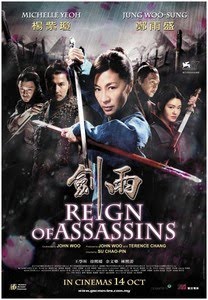
Reign of Assassins
My rating:


I was gonna start this review by talking about John Woo in the same way my Detective Dee and the Mystery of the Phantom Flame review talked about Tsui Hark - in that both are pioneering Hong Kong directors who went to Hollywood for a none-too-successful spell (although Woo did make one genuinely good movie there) and have since returned to their old stomping grounds. But the thing is, calling Reign of Assassins a John Woo film would be misleading. It's written and directed by Su Chao-pin, and Woo is a producer who got a little more hands-on than usual and earned himself a "co-directed by" credit. Still, it's fun to think of Woo and Tsui releasing competing costume action epics at the same time.

This is definitely the better one - but it does fall somewhat short of greatness.

Drizzle is a member of the gang of assassins known as Dark Stone, tasked by her leader Wheel King (Wang Xueqi) to steal the mummified remains of the famed Bodhidharma - a holy relic rumoured to possess mystical powers. But an encounter with a monk named Wisdom (Calvin Li) moves her to abandon her former life. She hides away the remains, undergoes a face-changing surgical procedure, and becomes the perfectly ordinary Zeng Jing (Michelle Yeoh); she even attracts the affections of the equally simple Jiang Ah-Sheng (Jung Woo-sung), who marries her and gives her a taste of wedded bliss. But soon her past catches up to her; Wheel King is still after the Bodhi's remains, and he has the rest of the deadly Dark Stone assassins - Lei Bin (Shawn Yue), the Magician (Leon Dai), and Turquoise (Barbie Hsu) - at his command.

Does or does not that synopsis sound like Kill Bill? It totally does, man! This is Kill Bill in Ming Dynasty-era China, in which The Bride gets a taste of an ordinary life and defends it instead of avenging its loss. Instead of the Deadly Viper Assassination Squad, we get Dark Stone, which sounds equally cheesetastic, and it's led by a Bill-analogue. And those names! Drizzle, Turquoise, Wheel King and Magician lack a unifying theme a la Cottonmouth, Copperhead and California Mountain Snake, but are no less cool. And there's a Macguffin in the form of the Bodhi's remains, which a bunch of folks called the Kongdong sect are also after - and okay, this is where the analogy breaks down. But I'm finding the comparison useful, since this movie sits squarely in the middle of the spectrum between Kill Bill on one end, and Crouching Tiger, Hidden Dragon on the other - and the latter is what it's trying to be.

It doesn't quite achieve that level, but it makes a game try. It starts off with a bang, then settles down to some gentle domestic comedy featuring the courtship between Jing and Ah-Sheng. Which is really quite charming, and establishes the emotional stakes for when the action starts up again later (although the fight scenes are noticeably bloodless, even when guys are getting slashed to ribbons by really sharp implements). There's a realistic and lived-in feel to the film, from the flawless production design - seriously, it's amazing that China can mount such pitch-perfect historical recreations - to the dialogue - little details like a shopkeeper reciting his accounts in silver and gold taels - that really fleshes out the world. And the characters are all interesting, even the minor ones; from the psychotic nymphomaniac Turquoise, to the taciturn Lei Bin who stands in opposition to Jing's desire for a normal life whilst having a wife and child of his own.

But there's also some pseudo-profound Zen philosophy that ultimately doesn't amount to anything. It's not very well-paced, and there's no real sense of mounting tension or rising stakes; one thing happens, then another thing happens, and finally it ends. There is some nice acting here though; Michelle Yeoh gets star billing, of course, and while she's not an actor with a great deal of range, here she gets to stretch her chops just enough and also showcase her terrific screen presence. Her co-star Jung Woo-sung is a little wooden, but he's likable enough as the big lug who loves her, and Barbie Hsu and Shawn Yue are also impressive. But there's also Wang Xueqi, a "prestige" actor in Chinese cinema who is very good in dramatic roles, but somewhat miscast as a mustache-twirling villain.

No, this film works better as a good old-fashioned kungfu action flick, the same kind that inspired Quentin Tarantino to make Kill Bill. It's got all the requisite tropes - the paralyzing nerve strike, aspirations to either rule the "world of martial arts" or retire from it, and seemingly invincible kungfu techniques that can only be countered by other secret techniques. But it's also got lots of neat little touches, such as primitive plastic surgery, wuxia CSI (a character studies the notches on a sword, and determines that it was used to fight someone who wielded a sword as if it were a sabre. This matters.), and a villain's motivation that's just the right kind of crazy-awesome. The fight scenes are, sadly, shot and edited in the usual tight shots and quick-cutting - all the better to hide the lack of real physical prowess in anyone not named Michelle Yeoh. But still, it's all really quite fun.

"Fun" is really what Su and Woo should've went for, instead of trying to make a stately and thoughtful wuxia epic a la Crouching Tiger, Hidden Dragon. Because they could've instead made something like Kill Bill - because there can be a beauty and profundity even in deliberately exploitative violence, as Tarantino managed to show us. Reign of Assassins aims for beauty and profundity and falls short, because Su isn't a filmmaker on the same level as Tarantino or Ang Lee and James Shamus. But he did achieve a smart, witty, affecting, and fun action movie, which ain't bad at all. (Oh, and do avoid looking up online sources of info on this film, all of which are stupid with spoilers. Even its Wikipedia entry gives away the major third-act plot twist in its first paragraph.)

NEXT REVIEW: Red
Expectations: looks like fun

Thursday, October 21, 2010

Tsui Hark and the Mystery of Where His Form Went

Detective Dee and the Mystery of the Phantom Flame
My rating:


Y'wanna know what's my all-time favourite Hong Kong movie? Peking Opera Blues, man. Directed by Tsui Hark, who is a justifiable legend of Hong Kong cinema. Every great Hong Kong film of the past 30 years has been influenced by him - but his heyday was a good decade-and-a-half ago. (Although to be fair, so was the HK film industry's.) He has returned from his short but embarassing sojourn in Hollywood making crappy Jean-Claude Van Damme flicks, but his films of the last few years have been hit-and-miss - and now he is part of that dubious league of filmmakers everyone wishes would return to their previous form.

He hasn't yet with this one. It only seems like it on the surface.

It is 689 AD in Tang Dynasty China, on the eve of Wu Zetian's (Carina Lau) coronation as the first female Empress. A giant Buddha statue is being built to commemorate her ascendancy - until two mysterious deaths by spontaneous human combustion halt the construction. Wu's loyal handmaid-cum-bodyguard Shangguan Jing'er (Li Bingbing) recommends enlisting the famous Di Renjie (Andy Lau), a court official who has languished in exile for 8 years for rebelling against the then-Regent Wu. With Jing'er and another court officer Pei Donglai (Deng Chao) tagging along, Detective Dee takes the case. He seeks the aid of the statue's architect and Dee's old comrade Shatuo (Tony Leung Ka-fai), as well as a medicine man named Donkey Wang (Richard Ng) - but a visit from the openly treasonous General Li Xiao (Lu Yao) exposes intrigues that could threaten the entire Middle Kingdom.

Tsui is most famous for reviving the wuxia genre, but at least one pie that he's always had his finger in is fantasy - see Zu Warriors from the Magic Mountain. And Detective Dee is much more a fantasy film than it is wuxia, making use of its historical China backdrop the same way J.R.R. Tolkien evoked the European Middle Ages. Ostensibly it's a detective story, in which seemingly supernatural mysteries are revealed to have mundane causes - but "mundane" is relative here, since the causes themselves are pretty far out there. So yes, fantastical detective story in set in Tang Dynasty China with plenty of elaborate action setpieces - it's the Guy Ritchie Sherlock Holmes meets Lord of the Rings in China. And directed by Tsui Hark. Sounds awesome, duzznit? It should've been - if it weren't such a complete and utter mess.

For one thing, the plot is incredibly confusing. Plot points are glossed over, characters get no proper introduction, and exposition is treated as an inconvenience to be done with as quickly as possible. This plus Tsui's penchant for throwing as much weird-ass stuff into his movies as possible means you'll be going "WTF?" every few minutes throughout. Not only are there character motivations to decipher and a mystery to be investigated, there's also a talking deer, a mace with +5 Sunder Weapon, steampunk robots, magical acupuncture, and some creepy-crawlies known as "fire beetles." And there's an underground Phantom Bazaar that seems to be Tsui's version of the Troll Market in Hellboy II: The Golden Army - but lacking Guillermo Del Toro's imagination (and budget), it's just a bunch of pale-faced guys in rags.

Which is emblematic of how Tsui's ideas in this movie far exceed his ability to execute them competently. I'm honestly shocked that this movie was made by one of the greatest film directors of all time. The direction is terrible. Over and over again, Tsui chooses the absolute wrong shot or camera angle. Not only does this make the plot hard to follow, it renders its lead actor's performance moot. Detective Dee is supposed to be a quirky genius in the vein of Holmes, as irreverent as he is brilliant. But every time he says something witty or does something clever or makes an ingenious deduction, the camera cuts to someone else's face. Whatever Andy Lau did with the role, for some inexplicable reason Tsui won't let us see it. (The rest of the cast aren't too impressive either; most of them struggle with the film's cheesy-melodramatic tone.)

And when did he forget how to film an action scene? Bad enough the fight scenes employ the kind of excessive physics-defying wirework of '90s Hong Kong flicks, once again the camerawork and editing ruin whatever thrills they could offer; they certainly hide whatever kungfu skill Lau, Deng Chao and Li Bingbing trained for. The sad thing is that the genuinely spectacular setpieces are the film's only saving grace, and it's enough to earn it 2-½ stars from me. The climax set within the interior of the giant Buddha statue - because of course you gotta have an action scene in such an elaborate set - is so full of this-could-be-so-cool that it's almost actually cool. But the mid-second-act fight scene between our three investigators and a mysterious assailant with a multi-vector assault mode (yes) is just sloppy.

Sloppy really is the best word I can think of to describe this film (and the sloppiness extends to the subtitles, which keeps referring to the fire beetles as fire turtles. Seriously, WTF?). Despite its quite technically proficient CGI and gorgeous production design, Detective Dee feels like one of those early-'90s cheapies that folks like Wong Jing would rush out half a dozen of in a year. But to be honest, Tsui himself cranked out a few of those during that time - so, is this, in fact, a return to form for him? Only in the sense that he's back to making the kind of wildly imaginative action movies he's most famous for - but not in the sense that he's made a good one. Which only goes to show that, even when playing with his favourite toys, he's still very much hit and miss. This one goes wide off the mark.

NEXT REVIEW: Buried
Expectations: aaaaa claustrophobia

Saturday, September 18, 2010

Because Fan Bingbing, that's why

Wheat (2009)My rating:


Yes, it's a 2009 movie, and it's only now come to Malaysia courtesy of GSC's International Screens program. (Which I recall was launched with some fanfare several years ago, with the goal of bringing quality foreign and non-mainstream fare to local audiences - and now they only release, what, a handful of films a year?) And the only reason why I'm watching and reviewing it instead of, say, Resident Evil: Afterlife, is this LoveHKFilm review - or more specifically, its description of leading lady Fan Bingbing as "insanely beautiful". I saw her in Bodyguards and Assassins last year, and damn, she is. Also, it was a positive review, so it definitely seemed worth watching.

Well, I didn't like it as much as LoveHKFilm did. But Fan Bingbing, man.

It is the Warring States period in China's history. Lu Yi is a remote town in the kingdom of Zhao comprised entirely of women, the men having gone to war with the state of Qin - including Lord Cu Jong (Wang Xueqi), the husband of Lady Li (Fan Bingbing), who is now the mistress of the city. One day two Qin army deserters, Xia (Huang Jue) and Zhe (Du Jiayi), find themselves in Lu Yi, and pose as soldiers of Zhao with a story of Zhao's glorious victory in battle, thus earning the adulation of the women. But the truth is that the Zhao army was completely annihilated, the kingdom is wide open for invasion, and the soldiers' deception will not hold for long.

I've been wondering if I'm not too fixated on genres and formulas - that in trying to pigeonhole every movie I watch into neat little boxes, I'm blinding myself to what they're really trying to accomplish. The premise of Wheat is similar to any number of films based on one or more persons deceiving a larger group of people and getting in over their heads (let's see, While You Were Sleeping, ¡Three Amigos, A Bug's Life - and yes, they tend to be comedies), and I kept expecting it to either follow those conventions or knowingly subvert them. Most of my dissatisfaction with the film arises from the fact that it mostly does neither.

It did not have an auspicious start, what with an opening scene that delivered exposition via extremely on-the-nose dialogue. ("Oh, it's so hard living in a women-only town in the state of Zhao where all the men have gone to war!" "Yes, but we loyally support the war against Qin, so let us patiently wait for our men to come home!") But it soon becomes clear that the film employs a kind of stylized theatricality, in the performances, the staging, the gorgeous wide-angle cinematography, even the exacting Zhang Yimou-ish art direction - f'rinstance, the uniform white workclothes that all the women of Lu Yi wear. Wheat clearly isn't going for gritty reality, so I can forgive a little on-the-nose dialogue.

What isn't as easy to forgive is its often directionless plot. The formula dictates that the soldiers would soon grow fond of Lu Yi (and why wouldn't they? Feted as heroes in a town full of lonely and horny women?) and eventually throw their lot in with them when their deception is revealed. But Xia and Zhe alternate between living it up, plotting to capture the town for Qin, and attempting to escape, with rarely any clear motivation for this constant gear-switching. When a group of bandits raid the town and attempt to turn it into their own personal fiefdom, this is the expected turning point where the soldiers fight them off and save their new home - but just minutes earlier, they were scheming to slaughter the women themselves.

Oh I'm sorry, were you expecting these guys to be heroic? They aren't, not very, at all. In fact, Zhe - the supposed bumbling comic relief of the two - is a borderline retard and played by an incredibly annoying Du Jiayi. He's just cowardly, greedy, selfish and stupid from start to finish. Xia is the typical soldier who's sick of war and just wants to go home to his farm (sentiments echoed in Jackie Chan's character from Little Big Soldier, and this kind of anti-war message is definitely a thing with Chinese cinema), and Huang Jue plays him with plenty of gravitas and charisma; it's a pity that, once again, his motivations just aren't very clear. Also, Wang Zhiwen is terrific in his one scene as the bandit leader - a grinning, viperously charming psychopath who treats all life, including his own, as disposable.

But Fan Bingbing, man. She's not only fabulous to look at, her performance is incredible and makes for reason alone to watch the film. It's not an easy role either; it soon becomes clear that Lady Li, as well as all the women of Lu Yi, have become increasingly unhinged from their loneliness and isolation. And since their inevitable fate is to be conquered by Qin, there can be no happy ending for these characters. Perhaps that's what He Ping is going for - a dark tragedy, in which whatever comedy there is is meant to be black. Maybe my preoccupation with genres and formulas blinded me to that, such that I couldn't tell if it accomplished what it aimed for. But I can be sure of this: as a vehicle for Ms. Fan, it's terrific.

NEXT REVIEW: 4 Madu
Expectations: it's Razak Mohaideen!