Showing posts with label Family-friendly. Show all posts

Thursday, December 27, 2012

The Pixar is strong in this one

Wreck-It Ralph
My rating:


As I have previously mentioned, it is not the best of times to be a Pixar fan. A couple of disappointing releases have slightly tarnished its record of knockout successes - slightly, because a disappointing Pixar film is still a pretty good animated family film by all but its own standards. Wreck-It Ralph is not a Pixar release, but it cannot avoid the comparison; it's still a Disney film, and has John Lasseter as an executive producer. More obviously, its premise of videogame characters with inner lives and personalities of their own not only recalls the Toy Story series, but also A Bug's Life, Finding Nemo and Cars - in Pixar's penchant for creating anthropomorphosized, richly-detailed worlds that also provide opportunities for lots and lots of in-jokes. And its 87% score on RottenTomatoes has already trumped Pixar's last two (Brave scored 79%, Cars 2 38%), raising the possibility that perhaps the parent company is beating them at the game they used to rule.

Perhaps. But only because of what they learned from them.

Wreck-It Ralph (John C. Reilly) is the villain of the Fix-It Felix, Jr. video game at Litwak's Arcade, and he is not very popular. While Felix (Jack McBrayer) is nightly celebrated by the inhabitants of their gameworld, Ralph doesn't even get invited to their game's 30th anniversary party. Wanting to be a hero for a change, Ralph sneaks into Hero's Duty, a 1st-person-shooter game - in which Sergeant Calhoun (Jane Lynch) is the main character - in order to win a hero's medal. He ends up in Sugar Rush, a kart-racing game, and meets Vanellope Von Schweetz (Sarah Silverman), a character with a sad story of her own: she's a "glitch", equally shunned by everyone in her candyland gameworld, and forbidden to participate in the races by King Candy (Alan Tudyk). Ralph and Vanellope partner up to get her in a race and win him his medal, and a friendship grows between the two. But if Ralph isn't in his game, Mr. Litwak will junk their console - and as Felix teams up with Calhoun to find him, they learn that a Cy-Bug monster from Hero's Duty has infected Sugar Rush, thus threatening to destroy two video game worlds.

The trailer prominently features a scene at Bad-Anon, a support group for video game villains, presided by one of the Pac-Man ghosts (Clyde, if you must know) and in which Zangief from Street Fighter, Bowser from Super Mario Bros and Doctor Eggman from Sonic the Hedgehog all make prominent cameos.  It's a hilarious scene, and it encapsulates much of Wreck-It Ralph's appeal: appearances by fan-favourite videogame characters, clever in-jokes, and a commitment to fleshing out the inner worlds of videogames right down to the characters. This is one movie you'll want on Bluray DVD so you can pause and admire all the visual detail - from the tiny cameos by more videogame characters (Chun-Li makes at least two appearances if I recall correctly) to the fact that Game Central Station, the terminal in between game machines, is literally a giant multi-plug socket on the inside.

Which is, of course, exactly what you expect of a Disney animated film, even a non-Pixar one. What matters more is a strong emotional throughline that makes us care about the characters, especially our titular hero. And it's there; on one level, we feel for Ralph when he's unappreciated and ostracised from his own gameworld - but on a deeper level, it's about his need to define himself beyond his assigned label as videogame bad guy. Which is echoed by Vanellope, a malfunctioning character in her game who just wants to participate like the rest of her peers. They go from annoying each other - well, more like Vanellope annoying Ralph - to a deep and heartwarming friendship based on their common desires and helping each other realise them.

It's just... we've seen this kind of thing before. Not just the funny anthropomorphosized world, but also the unlikely-friendship storyline. Two wildly differing characters will meet, bicker, then grow in affection towards each other, only to have a heartbreaking fall out, before reconciling in time for a triumphant climax. It's in the majority of Pixar films, as well as most animated films from other studios as well - in fact, come to think of it, it's the classic romantic comedy formula that goes way back beyond Pixar. Which gives Wreck-It Ralph a been-there-done-that feel that's just a little disappointing. It feels like Walt Disney Animation Studios - through director Rich Moore, and writers Phil Johnston, Jennifer Lee and John Reardon - is trying too hard to make a Pixar-ish film and deliberately aping their formula.

Which isn't to say their formula doesn't still work. The fall out is still effectively sad, as is the triumphant and uplifting climax. The jokes are funny, the action scenes are exciting, and the voice acting is terrific. (I did not recognise Alan Tudyk there.) But I wish the film had spent more time exploring other video games instead of staying in Sugar Rush for most of its second half; the videogame in-jokes are replaced by candy and confectionery in-jokes, most of which I didn't get. And having Felix and Calhoun fall for each other is a subplot that I didn't enjoy; Felix is uninteresting and poorly-defined for all the screentime he gets, and a character like Calhoun is an ill fit as a romantic interest. Lastly, there just isn't much depth here, nothing more emotionally resonant beyond its be-yourself/be-whatever-you-want-to-be message - which is yet another thing that's been done over and over again in animated films.

Am I expecting too much of this movie? Perhaps I am. Thing is, Pixar is (usually) better than this. They don't always recycle the formula, as with The Incredibles and Wall-E. Even when they followed it, they're daring enough to explore new narrative and thematic territory, as with Up and Toy Story 2 and 3. They've raised the bar high enough that a film like this - even as well-crafted and heartfelt as it is - just clears it instead of soaring above it. To be honest, I might even prefer something as ambitiously flawed as Brave than something content to merely be the Pixar film Pixar never made. Guess I'm a Pixar fanboy through and through; I'm still waiting for their next to knock all our socks off.

NEXT REVIEW: The Hobbit: An Unexpected Journey
Expectations: tempered

Saturday, July 7, 2012

Bravely facing disappointment

Brave
My rating:


The past couple of years haven't been the best of times to be a Pixar fanboy. Or at least, compared to the few years before then, when they had Ratatouille, Wall-E, Up and Toy Story 3 coming out one after the other. And even before then - before Cars, widely regarded as their first misstep - they had a string of massive successes stretching from The Incredibles all the way to the first Toy Story. It all started when they announced that their next film after Toy Story 3 would be Cars 2, a sequel to their least-liked movie and a not-inconsiderable critical disappointment - and although I still liked it, it was still a clear step down from their usual standard. So as any fanboy would, I placed high hopes on Brave, their 13th animated feature, to mark a return to their form.

And it pains me - despite the movie being pretty good, and one that I enjoyed quite a bit - to say that it isn't.

Merida (Kelly Macdonald), princess of the clan DunBroch, is a spunky and free-spirited teenage girl who loves shooting her bow and arrow, riding through the Scottish highlands, and generally seeking adventure. But although her father King Fergus (Billy Connolly) indulges her and her three younger triplet brothers, her mother Elinor (Emma Thompson) is a lot more strict. Elinor is trying to bring Merida up to be a proper princess, and has arranged to marry her off to a son of one of three allied clans. Rebelling against her mother's plans for her future, Merida comes across a witch (Julie Walters) and asks her for a spell that will change her mother, and thus change Merida's fate. She only realises what a grave mistake she has made when the spell changes Elinor into a huge black bear - one that her father mistakes for Mor'du, the bear that he once fought years ago and intends to seek revenge upon.

This isn't the first time a Pixar film's originator was taken off his or her own project and replaced with another director. It happened to Jan Pinkava and Ratatouille, amid disturbing rumours of a falling out - but the final product, under the new helm of Brad Bird, turned out just fine. It happened again with Brenda Chapman, to whom Brave was a highly personal story and Pixar's first to feature a female protagonist. This time, the results aren't as good, and it does not achieve the thematic and emotional depths of a truly female-centric film. (Yes, yes, I know, I am a man saying this. Wait. I can prove my point.) And though we may never know what went on behind the scenes, Pixar cannot escape the charge that firing Chapman is the cause of it all. They're not sexist; they couldn't be, if they could create female characters like Jessie the cowgirl, EVE, Helen Parr, even Dory. But Brave proves they can be as blinkered about the female perspective as, well, any all-male group can be.

See, it claims to be a story that's uniquely about mothers and daughters - specifically, the way the former hovers over the latter and the latter chafes under this treatment. I gotta ask: exactly how is this different from Hiccup and Stoick in How to Train Your Dragon? Or Flint and his dad in Cloudy with a Chance of Meatballs? Or any one of dozens of films featuring protagonists with daddy issues? You have your parental figure with expectations of a child that differs from the child's own ambitions, with all that juicy dramatic mix of love, disappointment, resentment and guilt that comes with it. That's exactly what happens with Merida and Elinor, and their story goes through exactly the same paces all those other movies do. (And makes poor use of Fergus, who is reduced to a bystander in the climax and should really have been given more to do considering that's his wife that's been turned into a bear.) In fact, Rapunzel and Mother Gothel in Rapunzel: A Tangled Tale were more interesting, and that film has a greater claim to being a uniquely female story.

That seen-it-before feeling pervades more than just the central mother-daughter relationship. There are echoes of How to Train Your Dragon (the Scottish accents), Hayao Miyazaki's Princess Mononoke (the will-o'-the-wisps) - and most strangely, Disney's own Brother Bear (a human being gets turned into a bear), Rapunzel (the heroine's horse that's almost, but not quite, a cute animal sidekick), and Beauty and the Beast during its climax. I'm not faulting it for not being 100% original - which is an impossible standard anyway, and besides, taking inspiration from such a disparate variety of sources could just as well produce something original. But the other films Brave is reminiscent of are all in the animated genre, which gives the impression not so much that it took inspiration from them, but that it simply didn't know - or care - that it's all been done before.

But as I said, I still enjoyed it quite a bit, as I knew I was going to. The gags are all terrific, in particular one hilarious one involving the witch's automated message system. Beautifully-rendered visuals are practically obligatory for Pixar films, but Merida's unruly shock of bright red hair is a particularly remarkable bit of animation and character design. As derivative as its final moments are, they are still well-crafted enough to stir the necessary emotion, and put a little sting into TMBF's eyes. I also liked how subtly the plot weaved together the witch's spell on Elinor, the demon bear Mor'du, and the legend of a rogue prince that Elinor tells Merida about in the beginning without spelling out the connections. And finally, the soundtrack is gorgeous and stirring; you simply can't go wrong with Gaelic hymns and traditional Scottish sounds. This is a movie worth sitting through the entire end credits - both for the music, and the funny post-credits scene.

Still, this is a disappointment. I hadn't expected much from Cars 2, and I was willing to allow Pixar their one revisit to their biggest cash cow - but this one I was hoping to be the one that got them back into their groove. It isn't. It had all the potential to be, but the magic simply wasn't happening. Which is a bitter pill to swallow for a Pixar fanboy like myself, so I'm thinking maybe it's time I cooled my enthusiasm. Maybe their winning streak has finally come to an end; maybe it's finally become too much to expect greatness from every single Pixar film. Their next, Monsters University - a prequel to Monsters, Inc. - certainly doesn't look like it'll be anything more than an entertaining trifle - which, ultimately, also describes Brave. So I think I'll do just that: expect every new Pixar movie to be merely good, instead of yet another of the finest animated films ever made. That's not something to be ashamed of... is it?

NEXT REVIEW: The Amazing Spider-Man
Expectations: so, what's new?

Sunday, April 15, 2012

A cartoon turned live-action, but still pretty flat

Mirror Mirror
My rating:


Due to my inexcusably long delay in writing my last review, I almost skipped this one; nowadays it seems like all I ever do is scramble to catch up with the newest releases. But seeing as there's another Snow White movie opening later this summer, I suppose it behooves me to catch the first of 2012's two competing modern takes on the classic fairytale, so I can compare them. (Hollywood parallel development always seems to happen in twos, e.g. two volcano movies, two big-space-rock disaster movies, two animated insect movies, etc.) Also because I'd missed out on Tarsem Singh's previous movie from earlier this year, The Immortals - and only because, again, I take so damn long to write these reviews. It was pretty damn tempting to just forego Mirror Mirror and pick Battleship, however.

But it would've been nice if the movie gave me a better reward for my choice.

Snow White (Lily Collins), the princess of her kingdom, lives with her stepmother the Queen (Julia Roberts), a cruel, petty and vain tyrant who has ruled the land since Snow White's father the King disappeared years ago. On Snow White's 18th birthday, she ventures for the first time in years outside the palace walls, and witnesses the suffering of her people - but this transgression turns the Queen's barely-tolerated irritation with her into outright enmity. The Queen orders her manservant Brighton (Nathan Lane) to take her into the forest and kill her, but she is found by a group of seven dwarf bandits - Grimm (Danny Woodburn), Butcher (Martin Klebba), Wolf (Sebastian Saraceno), Napoleon (Jordan Prentice), Half Pint (Mark Povinelli), Grub (Joe Gnoffo) and Chuckles (Ronald Lee Clark). Meanwhile, the visiting Prince Alcott (Armie Hammer) from a neighbouring kingdom has already met and fallen for Snow White - and has also met the bandits, under much less genial circumstances - but the Queen has her sights set on marrying him as the solution to her financial problems.

The only Tarsem film I've seen to date is The Cell, of which I remember little other than some spectacularly fantastical visual imagery that also has a pretty big streak of macabre. Mirror Mirror is also very pretty to look at, but Tarsem has also made a much more light-hearted and kid-friendly movie this time round. In fact, the shortest and sweetest description of it would be that it's a live-action cartoon - specifically, a DreamWorks-ish animated film in the vein of the Shrek series. The broad comic sensibility is there, as is the willful disregard of realism (this kingdom apparently consists of a palace and one village) and the snarky modern sensibility to a classic fairy tale. But frankly, to compare it to a DreamWorks production is both damning it with faint praise as well as overrating it.

Let's get into the specifics. The movie is almost entirely driven by its performances (certainly not by its plot, which is kinda messy), and there are two standouts. Julia Roberts always struck me as a curious choice to play fairy tale villain; the closest she came was arguably Charlie Wilson's War, which I enjoyed, but thought Roberts was terrible in it. She fares somewhat better here, in that she's clearly having fun in the role, a prerequisite for any actor playing a broadly comic scenery-chewing villain. Still, chewing scenery has never been her forte (and if I were to be honest in what I think of her, I'd say acting isn't her forte). I'd say pretty much any other female actor of her generation could've had just as much fun playing it and done a better job to boot. (When I said "standout", I didn't necessarily mean they were good; just that they made the biggest impression in the movie.)

The other is Armie Hammer, playing Prince Charming Alcott. There are hints of a role-reversal here, with Snow White coming to his rescue a couple of times and him being somewhat beleaguered throughout the movie (the bandits get the jump on him twice, leading to him showing up at the Queen's palace sans shirt - twice), but it never really commits to a girl-power interpretation of the tale; it doesn't help that in their one swordfight scene together, Alcott toys with the clearly ineffectual Snow White like a big bully. And then there's the part where he succumbs to a Love Puppy potion, which has him panting and licking other people and boo-hoo-hooing when he's away from his "master" like a literal puppy. What marks these two standout performances is that both performers really commit to them; Hammer certainly does in his puppy scenes. He's clearly enjoying himself, but turning him into a laughingstock is a curious - and dubious - choice.

And then there's Lily Collins, who was apparently chosen just because she looks the part. Snow White is dull, both due to Collins' performance as well as the writing. She has zero chemistry with Hammer, and their romance never stirs the heart. The seven dwarfs are fun to watch, but they're still a collection of caricatures rather than characters in their own right. There's also a late-third-act cameo by Sean Bean, and it'd be a spoiler to reveal who he plays (although it's also pretty predictable) - but the man looks positively embarrassed, tasked with injecting some gravitas into a movie that just spent 90 minutes having none. After all, this is a movie in which Nathan Lane is turned into a cockroach, then laments the fact that he had his modesty outraged by a grasshopper.

Okay, yes, it's entertaining. Yes, it's charming. Yes, its good-naturedly frothy fun is hard to resist. But it's all quite shallow; it's only funny enough to raise a chuckle but not hearty laughs, and only sweet enough to raise a genial smile but not genuine emotions. I couldn't shake the feeling that if this had been an animated film, it would've been better. It would've had more gags, prettier visuals, even better acting; it always seems as if it's being held back by the limitations of live-action productions. But even if it were animated, it would only prove that Shrek (at least the first one) did it better, and also had enough imagination to take on more than just one fairy tale. And even the Shrek series has been overshadowed recently by Disney, the grand master of modern animated fairy tale adaptations - with an assist from the Pixar brain trust. That's what I meant by damning with faint praise; it's reminiscent of DreamWorks, but not Pixar.

NEXT REVIEW: The Flowers of War
Expectations: White Hero saves Poor Pitiful Asians!

Monday, March 26, 2012

Not worth seeing

Seefood
My rating:


I know, I know, I've been greatly remiss on reviews recently, in particular reviews of local films. Which is why I wanted to catch this one, if only for its significance - despite the fact that The Hunger Games opened this week and I'm itching to watch it. Seefood is made by Silver Ant, a local animation studio that mostly does commercial and TV work, and this is its first full-length theatrical feature film produced in conjunction with Al-Jazeera Children's Channel. It's not Malaysia's first animated, or even CG-animated, movie by any means; I believe that'd be the Upin & Ipin movies, of which I think there are at least two. But since I missed those, I figure I'd better catch this one. Gotta check out what homegrown talent can do in the field of animation, hey?

And now that I have seen it, I can firmly tell you that you don't need to.

Pup (Diong Chae Lian) is a young bamboo shark living on a reef, and his best friend is a whitetip shark named Julius (Gavin Yap) who has a band of "assistants" - pilot fish Larry (Jason Daud Cottam), Moe (Andrew Susay) and Curly (who doesn't speak) - helping him stick to a no-fish diet. And there's also Mertle the turtle (Christina Orow), Octo the octopus (Kennie Dowle) and inventor, and Spin the stingray (Jay Sheldon) who resents Julius for trying to eat him. When two human boys from a nearby seaside village steal the eggs, Pup ventures onto land to try and save them - and promptly discovers that he can in fact breathe out of water. But when Julius and his retinue attempt to rescue Pup, they need Octo's invention - an exoskeletal suit for aquatic creatures. They'll encounter a band of none-too-friendly chickens, a restaurant owner who wants to serve Julius up as shark fin soup, and a somewhat friendlier coconut crab. But in the meantime, a nasty moray eel named Murray intends to lead an army of crabs in an invasion of the reef, riding a wave of sludge from the nearby industrial waste-spewing factory.

It will likely be argued, by fans and supporters of this movie, that comparing it with Pixar and DreamWorks productions - especially Finding Nemo - is unfair. To which I say: fair is for losers, sucka. Said argument might fly if this were North Korea or some other country with a trade embargo on foreign films. But this is Malaysia, where every CG-animated movie gets a wide release during school holidays (and where cinema distributors are canny enough to only release them during school holidays). You're targeting the same kids and parents and audiences who already watched The Adventures of Tintin, Cars 2 and Kung Fu Panda 2 last year, and it's not like you're charging a lower ticket price than those films did. There's no avoiding the fact that your movie will be held up to the same standards - and by those standards, Seefood sucks.

I knew the movie was in trouble by the opening scenes. There's no proper establishing of key story points: what exactly is Pup's and Julius' relationship, and why is Julius protective of the former? Why is Pup concerned about the batch of eggs? Why does Julius have an entourage of three sycophants following him around all the time? If Julius is on a "vegetarian" diet, then why is he offering up a bunch of other - live, and terrified - reef denizens to Pup as snacks? (And in lieu of fish, Julius has been eating tyres?) And then we're asked to swallow Pup being able to breathe on land - which is actually true, bamboo sharks have been known to survive up to 12 hours out of water, though I highly doubt they can run and jump and push trolleys while they're at it. It's just that the information isn't presented in a way that makes it halfway plausible.

There's a weird thing going on with Jeffrey Chiang's screenplay here. The movie contains long stretches without any dialogue, and it's like director Goh Aun Hoe cut out a lot of Chiang's lines because he thinks his "visual storytelling" can do the job better. This would seem like a wise decision, because Chiang's dialogue is terrible. There isn't a single funny, witty or clever line, just cliché after cliché; Chiang is literally writing at a kindergarten level of English literacy here. None of the characters are interesting or fleshed-out - in particular the one-dimensionally nasty human villains - and its attempts at an ocean conservation message are trite and perfunctory. Its one clever idea, the fish mech suit, shows up only a good halfway through the movie, and even then neither Chiang nor Goh do anything clever with it. Even for a CGI cartoon movie for kids, its lack of respect for its audience's intelligence is evident. Just look at the character names: Chiang names an octopus Octo. Bet it took him weeks to come up with that one.

I said it would seem like a wise decision, because frankly, Goh's visual storytelling skills are equally awful. I swear to God, he never wastes a single opportunity to ruin the comic timing of a visual gag. What passes for action scenes during its climax are also mind-numbingly lethargic. It's dull; the pace is interminable, making its 92-minute running time feel like 2-½ hours, and Chiang's screenplay probably takes up all of 50 pages. Also, the movements of the human characters are ugly and unnatural (the fish and chicken characters fare better, because anthropomorphic characters are at less risk of falling into the uncanny valley). It's embarrassing that this movie was made by one of Malaysia's top animation studios and this is the best they can come up with. Its only saving grace is the visual design of what looks like an idyllic Malaysian seaside village - but even this is undercut by the villagers speaking in perfect American accents.

There's no getting around it: Seefood is not funny, not thrilling, not heartwarming, not engaging, not imaginative, and just plain not good. And now that I have so brutally trashed it, you may be more sympathetic to the position that comparing it with Hollywood CG-animated films is unfair. To which I say, again, no. How is it unfair? The only really unfair advantage they have over Silver Ant is their multi-hundred-million-US-dollar budgets - which isn't something that Goh and his animators can't overcome, since Seefood looks perfectly decent from a technical standpoint. Where it fails is in character design, animation direction, storytelling, and basic imagination. If you're going to claim a mulligan for all these - if you think you deserve a pass because you're just not as good in these areas as Pixar or DreamWorks - then why the hell did you even make this movie??

NEXT REVIEW: The Hunger Games
Expectations: pretty excited, yo

Friday, December 23, 2011

The Muppets are as sweet and earnest - and magical - as ever

The Muppets
My rating:


It was either this or Arthur Christmas for my next review. I'm missing out on a lot of big movies in an (increasingly desperate) attempt to catch up on current cinema releases; although the Aardman Studios animated film has been garnering great reviews, I ultimately chose The Muppets due to its greater, um, shall we say, "cultural significance." (Even though its cultural significance here in Malaysia is somewhat suspect.) Boy, I'm glad I did! I'd forgotten that the new Toy Story short from Pixar, Small Fry, is attached to it, and I would've hated myself for missing it. Although it feels like a massively shortened version of the first movie (Buzz gets left behind again), the hilarious spoofs of cheesy fast-food kid's meal toys make up for it. And of course, it's a pleasure just to see Woody and Buzz and the rest of the gang on the big screen again.

And The Muppets? Glad I caught it too.

Gary (Jason Segel) and Walter (voice of Peter Linz) are adopted brothers and lifelong fans of the Muppets - especially Walter, who is clearly a Muppet himself but apparently no one ever comments on this fact. On the 10th anniversary of Gary's and his girlfriend Mary's (Amy Adams) relationship, they go on a trip to Los Angeles and bring Walter with them, who is especially excited to visit the famed Muppet Studios. But upon arrival, they find it run down and the Muppets disbanded, having lost their popularity. Worse, an evil oil baron named Tex Richman (Chris Cooper) is planning to buy the property, tear it down and drill for oil. Thus, Gary, Walter and a slightly reluctant Mary must gather the old Muppet gang - Kermit the Frog, Fozzie Bear, Gonzo, Animal, Miss Piggy, Swedish Chef, Rowlf, Camilla the Chicken and all the others - and save the day the only way they know how: by putting on a show. But first, they must convince hard-nosed TV executive Veronica (Rashida Jones) to give them a slot, then get Jack Black (Jack Black) to be their celebrity host - and finally, defeat the machinations of Richman, who mean to ruin them at any cost.

Did The Muppet Show ever air in Malaysia? TMBF was a bona fide TV addict throughout the '80s, and I don't recall ever seeing it. (And I recall Fraggle Rock.) There's a great deal of love and nostalgia for the Muppets amongst the pop-culture-geek websites I hang out on, none of which I or anyone I personally know feel; sure, I've heard of Kermit and Miss Piggy through cultural osmosis, but that's about it. So I came to this movie with none of the pop-cultural baggage that it seems to be deliberately addressing - such as the basic storyline about how they've fallen in popularity and need to convince the world, both in the film and in real life, that they're still relevant. I also came to this movie with a somewhat removed impression of the Muppets' appeal, i.e. I know people like them because they're charming and funny and cute, but I haven't really experienced it myself. Now that I have, I can sum it up in one word: sweetness.

Which is a difficult thing to aim for, since it can so very easily end up as cloying sentimentality. It's also very easy for most people to adopt a cynical, cooler-than-thou hipness that looks down on something as unfalteringly clean and cheery as the Muppets. But I see now that what makes them so beloved - and what this movie succeeds at capturing - is their ability to make sweetness sweet, and not cloying or corny. This is a delightfully candy-coated confection of a film, one that knocks down every wall of cynicism to put a gleeful, child-like smile on your face that you can't wipe off - to paraphrase a lyric from one of its songs. And yes, it has songs; it's a musical, which I've said before is my least favourite genre, but this movie shows that there's nothing like a showstopping, intricately-choreographed song-and-dance number to convey effervescent joy. That's what The Muppets offers - effervescent joy.

How does it accomplish that? First, by being very very cute. In this day and age when there's a multi-billion-dollar corporation that does nothing but create marketable icons of cute, it's enlightening to consider what Jim Henson created 35 years ago through the old-school art of puppeteering. Second, by investing each and every one of those creations with personality - something Sanrio has never bothered to do - via voice acting, puppetry, and plain ol' good storytelling. Third, by adopting an ironic sense of humour that pokes fun at itself more than anything, which therefore gives it license to also poke fun at everything. The funniest jokes in this movie come from its gleefully fourth-wall-breaking moments - like when an entire chorus line collapses in exhaustion after the principal characters leave the scene, or even offhand bits like when Kermit first balks at Walter's plea to reunite the Muppets and Mary says, "This is going to be a very short movie."

But where it resolutely refuses to descend into irony is in the emotional subplots - Gary's and Mary's relationship issues, Walter's identity crisis, even Kermit's and Miss Piggy's on-again off-again romance. Which tend to bog the movie down in its midsection; none of them have any real dramatic weight for the amount of screentime they take up. Albeit the Kermit-Miss Piggy one works better, since the Muppets' brand of earnest sentiment works better when it's played by Muppets instead of flesh-and-blood actors. Because if there's another word that best describes the Muppets, it's earnestness. It's there not only in the sentimental scenes, but also in its entire approach to entertainment at its cheesiest. It's what accounts for Camilla and gang clucking their way through an all-chicken rendition of Cee Lo Green's Forget You (the clean version of the song, of course), as well as the bit where Chris Cooper starts rapping. The former is fun - the latter is a little cringe-inducing. Just as well that neither goes on for too long.

But I feel guilty just for saying the slightest uncomplimentary thing about it. A Muppet movie isn't supposed to be dramatically weighty, after all. It's not a great film, as my rating indicates, and I wouldn't even place it among the year's best. It's just a highly entertaining little movie that kids will enjoy, that'll turn hardened adults into kids again, and that'll leave a smile on your face that'll last a lot longer than most empty-headed kids' movies. (Despicable Me, I'm still looking at you.) Still, I wouldn't put it past some people (Malaysians in particular, if only because we never grew up watching The Muppet Show) to be immune to the Muppets' charms - to think of a movie starring old-school, non-CGI-animated puppets to be uncool. Just look at Walter, the one new Muppet character created for this movie, and see how the same piece of inanimate felt can convey heartbreaking sadness, overwhelming joy, and the entire gamut of emotions in between. There's a magic in that - magic that Jim Henson discovered and that his successors carry on. For those on whom that magic doesn't work, you clearly live in a colder and bleaker world than the rest of us.

NEXT REVIEW: Mission: Impossible - Ghost Protocol
Expectations: wow, AV Club, really?

Tuesday, November 22, 2011

The exciting adventures of a dull hero

The Adventures of Tintin: The Secret of the Unicorn
My rating:


Oh yes, I certainly remember Tintin. I remember a good many hours spent plonked down on the floor of an MPH or Times bookstore, reading the comics from cover to cover. Between this and borrowing my friends' issues (I never owned any, but now that I have plenty of disposable income and the freedom to spend it on the trappings of my childhood, I should really consider getting 'em all), I pretty much covered all twenty-three of them (except the unfinished twenty-fourth). They were wonderful comics, a delightful blend of action, adventure, comedy, and a gorgeously romanticized view of the mid-20th century. So now there's a movie, directed by Steven Spielberg, produced by Peter Jackson, and written by Steven Moffat, Edgar Wright and Joe Cornish - all highly prestigious names, not to mention highly reliable at delivering quality filmic entertainment. Naturally, the first question would be: is it a faithful adaptation?

The answer is yes. But fidelity to the source material isn't the biggest issue here.

When world-famous reporter Tintin (Jamie Bell) purchases a beautiful model of a 17th-century sailing ship - the Unicorn - he finds himself caught up in the ancient mystery of the actual Unicorn and its captain, Sir Francis Haddock. A man named Sakharine (Daniel Craig) is willing to commit murder to uncover that mystery, and Tintin's quest to beat him to it will lead him on a continent-spanning adventure - accompanied, as always, by his faithful dog Snowy. Along for the ride is the alcoholic Captain Haddock (Andy Serkis), descendant of the Unicorn's original captain and an important key to the mystery; also occasionally turning up to lend a not-very-helpful hand are the dimwitted Scotland Yard detectives Thomson (Nick Frost) and Thompson (Simon Pegg).

Okay, confession time: it's actually been years since I opened the covers of a Tintin comic. I had to check the movie's Wikipedia entry to learn that the storyline is cobbled together from three of the comics: The Crab with the Golden Claws, The Secret of the Unicorn and Red Rackham's Treasure. Which is a logical choice, seeing as it combines Tintin's and Captain Haddock's first meeting with the adventure in which Haddock's background features most prominently. And in knitting together these three issues into a seamless movie plot, Moffat, Wright and Cornish earn their paychecks. As do the army of CGI animators who created the gorgeously detailed locations, and Spielberg for both the fun action scenes and the wholesome, old-fashioned adventure tonality in which they inhabit. It's a fun movie, more fun than anything Spielberg has made in years - and that includes Indiana Jones and the Kingdom of the Crystal Skull.

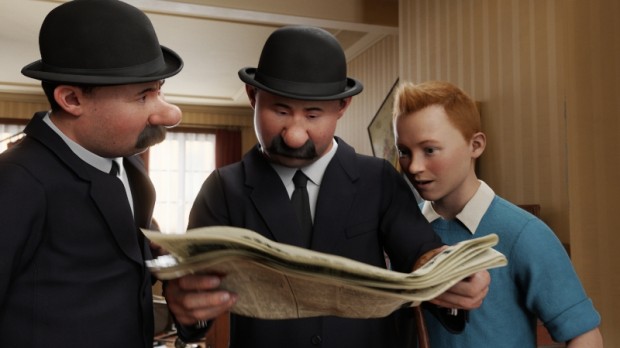
But it's in pseudo-realistic motion-capture 3D animation. And my dislike for this particular animation style has not abated; in fact, I'm dismayed it picked up another two advocates in Spielberg and Peter Jackson. I've already discussed how it always makes characters look dead-eyed and inexpressive, and that problem is present here - in its titular protagonist, no less. Look at the publicity stills - that dull, slack-jawed look is pretty much permanently affixed to his face. It could be argued that the original comic Tintin is a deliberately blank slate as well, with no distinct personality nor backstory, but Hergé still knew how to draw him with expressions. Hergé's Tintin was never dull, which is what Spielberg's Tintin is. And this isn't an uncanny valley problem, which this movie quite successfully avoids; Haddock and Thomson and Thompson are enjoyably expressive, largely because their features are deliberately cartoonish. This Tintin is dull by design.

This exacerbates another problem when the movie gets to its action scenes. There's a midsection chase scene through a Moroccan city that's superbly well-choreographed, employing a camera that swoops through a single tracking shot in ways that would be impossible in live-action (and must've had Spielberg creaming in his pants). It's thrillingly good fun, and nicely brings Hergé's own wildly slapstick action scenes into the cinematic medium. But there's one part - which can be seen in the trailer - in which Tintin rides a motorcycle off a ledge, it breaks into pieces, leaving him holding the handlebars, which he uses to zipline down a telephone cable in pursuit of a hawk that has stolen the Macguffin. What is he thinking and feeling in this scene? Is he a fearless daredevil who thinks nothing of performing such acrobatic feats? Or is he in absolute terror at the death-brushing predicament he got himself into, as any normal person would be? We don't know. Because we never see his face in this scene.

Compare that to a similarly wild action scene in Cloudy with a Chance of Meatballs, in which the hero free-runs through the flying debris of a tornado, then gives us a moment to show his emotional reaction at, well, having survived a free-run through a tornado. This is important, guys. Knowing what's going through our hero's mind is crucial in the immersive experience of a film, especially so in an action scene. Because otherwise, it's no more than a shallowly spectacular circus act by performers whom we don't know and have no emotional investment in. What's sad is that Spielberg used to know this. That's how he directed the Indiana Jones movies, with a game collaborator in Harrison Ford; his "oh shit oh shit I don't know if this is gonna work" look, his "aaaa nooo we're gonna diiiiee" look, his "enough enough I give up just kill me please" look, and his "okay that is it I have had it this ends right now" look are exactly what made Indy the greatest action hero of all time. And now, Spielberg gives us an action hero who performs feats Indy could never have dreamed of, yet never looks anything more than mildly flustered.

Comparing it to a more cartoony 3D-animated film also raises another problem with this movie, and with the whole pseudo-realistic style as a whole. Namely, is it realistic or not? Are we meant to be seeing a representation of live-action reality, or the deliberately exaggerated slapstick of a cartoon? Insanely over-the-top action sequences like the Morocco chase are fine if it's the latter, but in the former are just unbelievable and phony. This confusion somewhat marred my enjoyment of this and its other action scenes, as thrilling and as well-staged as they are. Even its non-action scenes; some of its jokes and gags, while taken directly from the comics, come off as cheesy and kiddish. Again, they'd be funny if it were made clear we're watching a cartoon (or at least, one in which the main character looked as much like a cartoon as everyone else in the movie), but therein lies the inherent problem of the pseudo-realistic motion-capture animation genre: it's this nebulous, confusing, neither-one-nor-the-other middle between live-action and animation, between realism and heightened realism.

Yeah, I do this a lot - writing ostensibly favourable reviews that spend more pixels on criticising the movie than praising it. And then I wrap it up with a concluding paragraph that says, okay, seriously you guys, it's still a good movie. It's good old-fashioned all-ages fun, and a fair and loving tribute to Hergé's comic creation. But it could've been a lot more - not just a truly brilliant film adaptation of the unequivocally brilliant comics, but a worthy reprise of Raiders of the Lost Ark, to which Spielberg is clearly paying self-homage. Kingdom of the Crystal Skull sorely disappointed me and made me suspect he's losing his touch, but The Adventures of Tintin: The Secret of the Unicorn confirmed it; he's forgotten that one simple thing that made his older movies so genuinely thrilling, instead of superficially so. Oh well. Maybe the sequel - which Peter Jackson is directing - will be better.

NEXT REVIEW: Abuya
Expectations: oooohohoho

Sunday, October 23, 2011

The steel is stronger than the flesh

Real Steel
My rating:


Real Steel earned a fair bit of derision in the months leading up to its release. We've been threatened by told of a couple of Hollywood projects that aim to adapt toys and boardgames into movies, and this one seemed for all the world like Rock'em Sock'em Robots: The Movie. Which is probably a laughable concept to anyone familiar with the ages-6-and-up toy, but I'm not one of them; I've never played it. Still, while it isn't the dumbest toy/game to be turned into a movie (I'm still waiting for Ridley Scott's Monopoly), the trailers made it look like a pretty silly Rocky/Over the Top ripoff with battling CGI robots in place of boxing or arm-wrestling.

It is exactly that. It is also, surprisingly, pretty good.

In a near future where "the fight game changed" and robots have taken over human fighters in the sport of boxing, former boxer Charlie Kenton (Hugh Jackman) now ekes out a meagre living taking battered old robots to underground matches - and more often than not, getting trashed. One day, he is informed that an old girlfriend has passed away and left him an 11-year-old son, Max (Dakota Goyo). The boy's aunt (Hope Davis) wants to adopt him, but Charlie works out a deal in which he will take care of Max for the summer for a cash payout. He intends to leave him with his old flame Bailey (Evangeline Lilly), a boxing gym owner, but Max insists on following him on tour. Later they find a battered old sparring robot in a scrapyard that Max names Atom, although no one - not even Charlie, initially - thinks much of it. But with Max's faith, and Charlie's tutelage in boxing moves, Atom starts winning more and more fights - and eventually earns the notice of Zeus, the undefeated world robot boxing champion, and its arrogant rich owners (Olga Fonda and Karl Yune).

I've just realized that I rarely apply the Family-friendly label on a review of a live-action film. Partly because it's hard to define, and partly because I often see it as a vote of confidence that I'm not always keen on giving - as if I am recommending that people take their kids to watch it. (The recent version of The Three Musketeers might qualify as a family film, but I'm not labeling it as such because it sucks.) Real Steel, however, is one movie I have no compunctions against giving the Family-friendly label. Partly because it clearly has a kid main character, and partly because it's good. In fact, kids will probably love it a lot more than adults, and if the robot toys are in stores by now then I bet they're flying off the shelves as we speak.

Of course, 3-½ stars only means it's good, not great. It's still a very formulaic underdog-sports-movie-cum-father-son-bonding-movie, with a side of boy-and-his-dog/animal/robot/otherwise-non-human-friend movie, and it generally pulls off all these elements well. In fact, a couple of critics have noted its similarities to the Transformers movies, and you can go ahead and replace "noted its similarities to" with "think it's much better than". I think so too, although it isn't quite because Shawn Levy is a better director than Michael Bay. (He is on AV Club's list of 10 Directors You Didn't Know You Hated, after all.) He tends to lay on the schmaltz a little thick, his approach to humour can be a little annoyingly juvenile, and there ain't a damn thing subtle about his storytelling.

But the one thing he does better than Bay is to film the robot boxing scenes clearly and coherently. And it helps that he got the legendary Sugar Ray Leonard to choreograph the fights, turning them into genuinely crowd-pleasing action scenes. Unlike its storyline's future-world conceit, I'd still rather watch two humans duking it out - it doesn't hold a candle to Warrior's fight scenes - but it's definitely thrilling to watch two 600-pound machines pounding on each other. (Although I couldn't help but wonder about this robot boxing business. Those things have safety subroutines, right? Something to prevent Atom from knocking someone's head off when Max leads it dancing down a crowded aisle? And when it lies prone after being knocked down, and takes a suspensefully long time to get up - what exactly is going on in that robot brain and chassis? Rebooting its system? Re-lubing its hydraulics?)

I suppose this is a step up for Levy, who was last seen round these parts interfering with Steve Carrell's and Tina Fey's comic chemistry in Date Night and making the oddly action-deficient Night at the Museum 2. It's also a step up for Hugh Jackman, who was last seen round these parts in X-Men Origins: Wolverine and deserves to be in a well-liked movie for a change. Charlie is a charming ne'er-do-well, a role that Jackman can pull off easily; although there are parts early on where his self-destructive streak gets a little too hard to like, Jackman's innate screen presence manages to sandpaper over it. Dakota Goyo is being hailed in some quarters as the next great child actor, but he's just okay to me. He's not called to do much except act precocious, and though he has an enjoyably contentious chemistry with Jackman, the sentimental scenes are still schmaltzy. I thought Evangeline Lilly did more with the little screen time she had.

Okay, I've spent this entire review delivering faint and qualified praise. I suppose I'm just reacting poorly to how many people are hailing it the best goddamn movie of the year, which, no, not even close. Although of course they would, seeing as how it's such a shameless crowd-pleaser. And that doesn't take away from how effective it is as a crowd-pleaser, with a nicely rousing climax. Or that it does a couple of things surprisingly well; I liked how subtly it weaved in - and paid off - Charlie's history as a (human) boxer. Twenty-five years from now, folks will probably look back on this with nostalgic warmth, same way adults of my generation think fondly of, say, 1986's Short Circuit. But it sure as hell ain't no Back to the Future or Ghostbusters.

NEXT REVIEW: Klip 3GP
Expectations: socially relevant techno-thriller or sleazy sexploitation flick? Hmm

Wednesday, August 31, 2011

A model that doesn't live up to its make

Cars 2
My rating:


A good friend and fellow movie buff has described Cars 2 as "the boss' pet project." See, in 2006, Cars was the first film John Lasseter had directed since 1999's Toy Story 2, and this sequel is his only other film in the five years since then. In interviews, Lasseter has talked up his love for the sport of auto racing and the historic U.S. Route 66 highway that inspired the first film. And also, he's the Chief Creative Officer of Pixar, as well as of Walt Disney Animation Studios. So yes, this being the boss' pet project is as good a reason as any for why Pixar chose to make a sequel to one of their least-loved movies; the only other reason is that its least-loved movie is also its most money-making, with merchandise sales in excess of $5 billion. And then the movie came out in June and earned Pixar's worst critical drubbing ever, scoring only 37% on RottenTomatoes. It's enough to make a true-blue Pixar fanboy like myself despair.

Okay, Pixar is still Pixar. But yeah, this is the least Pixar-like Pixar movie since, well, ever.

Lightning McQueen (Owen Wilson) is now a world-famous racer who has returned to his home of Radiator Springs and his closest friends, especially Mater (Larry the Cable Guy). Then they learn of a new race organized by billionaire Sir Miles Axelrod (Eddie Izzard) as a means to promote his new biofuel; provoked by taunts from Italian racer Francesco Bernoulli (John Turturro), McQueen decides to take part, this time bringing Mater with him to the race's international locales such as Japan, Italy and England. But Mater's simple-mindedness and ignorance end up embarrassing him and drives a wedge in their friendship - and in turn, leads to Mater getting embroiled in a deadly spy plot. British intelligence agents Finn McMissile (Michael Caine) and Holley Shiftwell (Emily Mortimer) mistake him for a secret agent, and recruit him into foiling a conspiracy to sabotage the race, conducted by the evil genius Professor Zündapp (Thomas Kretschmann) who is working for a secret mastermind. A conspiracy that may have deadly consequences for the racers - including McQueen.

As you can probably tell, I have a weakness for animated family films. Two of my No. 1 best films of the year have been from Pixar, and I've been mostly quite generous in my opinions of even non-Pixar offerings (except for Despicable Me, and nothing's gonna convince me it was good). Cars 2 is about as good as the more recent DreamWorks Animation releases, which means it's still quite good; it's a bright, imaginative, clever, and perfectly enjoyable movie that will keep kids enthralled and adults entertained. But Pixar's usual, self-ordained standard is to keep both kids and adults enthralled - the former with dazzling visuals, the latter with either thought-provoking ideas or heartrending emotional weight and often both. And their latest film just doesn't match up, largely because it only has one of those to offer.

The first Cars was about humility, maturity, and finding something worth loving more than one's own self. Which, in execution, wasn't quite as engaging as Toy Story 3's ruminations on mortality or Up's meditation on grief and loss, but at least it was about something. Cars 2 is about how Mater should be comfortable being himself - which, okay, is something, but it's also terribly hackneyed and trite. It's a tired old cliché of kids' movies, and it's even been done better in films like How to Train Your Dragon and Cloudy with a Chance of Meatballs. None of the supposedly poignant scenes between McQueen and Mater stir any emotions, and it doesn't help that the "himself" that Mater ought to be is an idiotic redneck stereotype. "Being yourself" is the wrong lesson to learn if you're a buffoon to begin with! Sure, he eventually redeems himself and saves the day with his unique Mater-ness, but that's just Screenwriting 101. Pixar is usually much better at storytelling than this.

Fact is, the friendship between these two wasn't even the most affecting relationship in the first film; that'd be the one between McQueen and Doc Hudson, voiced by the late Paul Newman. Both character and actor get a tribute in an early scene that feels clumsy and tacked-on, and serve only to remind us that Cars, despite being the weakest entry in Pixar's ouevre - till now - was still a characteristically Pixar story. More proof that Cars 2 isn't is the fact that its new characters are all one-note and underdeveloped. Neither Michael Caine nor Emily Mortimer are impressive as Finn McMissile and Holley Shiftwell, mainly because all they do is follow the plot; there's a half-hearted attempt at a romantic subplot between Holley and Mater that's just half-hearted. And Finn's arsenal of gadgets is fun, but for the most part he just plays second fiddle to Mater. For the amount of screentime they have, neither of them possess the depth that Pixar is known for investing in their characters.

But Cars 2 does improve on its predecessor in one respect. In my Retro Review of Cars, I mentioned that it's slow and self-indulgent, but its sequel makes up for that with its action scenes. They're fun, frantic, filled with clever and witty touches, and not to mention frequent; parents needn't worry about the kids getting too bored with the talky bits before the cars start chasing and shooting at each other and blowing things up again. Another thing Pixar is an acknowledged master of is the genuinely thrilling action scene, and on that score this movie delivers. It is also typically great to look at, and moving the story out of Radiator Springs allows it to show us some gorgeous visual design; I thought the Porto Corsa locale of the second race was especially beautiful. We also get to see a lot more of this world of anthropomorphic automobiles - which, yes, doesn't make a lick of sense, but it is what it is: an excuse for lots and lots of car puns, both verbal and visual. Some of them may be groaners, but hey, I like puns.

So once again, it's a fun and enjoyable movie and perfectly serviceable as family entertainment. It just isn't more than perfectly serviceable, which is what we've come to expect from Pixar. And being a fanboy of theirs, I can't help but wonder why they made this, and why they made it like this. Maybe it really is the boss' pet project; maybe Pixar's true legacy is being carried on by folks like Pete Docter, Andrew Stanton and Brad Bird, and maybe Lasseter is losing his touch - which is sad for the man who directed Toy Story and Toy Story 2. Or maybe the real reason is this. Which, if it is true, I'm more than willing to forgive them for. Let them get their moneymaker out of the way, let them silence their shareholders, let them earn the creative freedom they need to make masterpieces once again. Let this just be a minor misstep, or a necessary evil - and not, God forbid, the start of a decline.

NEXT REVIEW: Conan the Barbarian
Expectations: I love this stuff, it can't be that bad - can it?...

Wednesday, July 27, 2011

It all ends, but not for me

Harry Potter and the Deathly Hallows, pt. 2
My rating:


So with the release of Harry Potter and the Deathly Hallows, pt. 2, the Harry Potter saga finally comes to an end - the movie version of it, that is. But if you place it within the larger picture of the books' publication dates, the 10-year production of all 8 films becomes a 14-year odyssey that began from the release of J.K. Rowling's first book - the one that started it all, Harry Potter and the Philosopher's Stone, in 1997. In a way, such a broader perspective is appropriate; there will now be no more new adventures of Harry, Ron and Hermione whether in novel or movie form. (In the foreseeable future, that is.) But I confess that, having never read the books, and having come late to the movies, I'm not really feeling the momentousness of it.

And I think that's probably because the books and the movies ought to be thought of as separate entities altogether.

Harry Potter (Daniel Radcliffe), Ron Weasley (Rupert Grint) and Hermione Granger (Emma Watson) continue their search for the remaining Horcruxes that house the parts of Lord Voldemort's (Ralph Fiennes) soul, even as Voldemort recovers the all-powerful Elder Wand from Dumbledore's (Michael Gambon) tomb and solidifies his power. First they stage a daring raid on Bellatrix Lestrange's (Helena Bonham Carter) vault at Gringotts bank, but then Harry learns that another Horcrux is hidden at Hogwarts - where Severus Snape (Alan Rickman) is now headmaster. Arriving there, the three reunite with old friends and allies, including Dumbledore's brother Aberforth (Ciaran Hinds), Professor McGonagall (Dame Maggie Smith) and Neville Longbottom (Matthew Lewis). But this alerts Voldemort, who lays siege to the school with an army of his Death Eaters. In the ensuing battle, Harry will learn the final few secrets that Dumbledore has kept hidden from him since his birth - secrets that Snape has also kept, for his own reasons.

I've said before that I like the Harry Potter movies when they're dark and action-packed, and this is the darkest and most action-packed one yet. Not only does the Battle of Hogwarts take up almost the entire second hour, there's an almost unremittingly bleak tone throughout the entire film that builds on from Part 1's pervasive sense of hopelessness. There are almost no moments of triumph, and even the raid and escape from Gringotts plays up the desperation of our three heroes rather than making it a rousing feat of derring-do. And in one stunning sequence later on, the three race across a pitched battle between the beleaguered defenders of Hogwarts and Voldemort's forces comprising Death Eaters, ogres and giant spiders - and Alexandre Desplat's score is not tense or heroic, but moody and poignant.

And all credit for this goes to David Yates, for this uncompromising approach towards portraying the relentless despair and overwhelming odds facing the good guys. Which does not only include Harry, Ron and Hermione; Yates once again successfully conveys the scale of an entire world on the brink of destruction. Hogwarts, so cheery and magical in previous installments, is reduced to a post-apocalyptic ruin here; even before the battle, under the headmastership of Snape, it seems more like a prison camp than a school. But Yates does not go the Michael Bay route of non-stop, punishing action; he knows when to slow down for an expository or emotional moment, wringing the storyline for every operatic, towering emotion it's worth. This is the kind of epic fantasy filmmaking that hasn't been seen since Lord of the Rings: Return of the King.

Which isn't to say it's without flaws, since neither was Return of the King. The dangers of making an epic film, with its epic heights, is that the higher you aim the further you have to fall. Yates, and perennial Harry Potter scribe Steve Kloves, are not immune to the occasional cheesy or clichéd moment - and admittedly, I don't know if they're the inventions of Yates and Kloves or if they were present in Rowling's writing. The ones that come most readily to mind are Neville's speech, and his exhortation that Harry lives "in here!" (points to heart), and a scene set in a glowy ghostly afterlife complete with pep-talk from dead mentor. Yates is not the massively self-indulgent filmmaker Peter Jackson is, but here he fails to avoid some of the same pitfalls that befell Jackson. When you're aiming for capital-E Epic, you've set a very high standard for yourself that you may not always hit.

But most of the time, the film does, don't get me wrong. Yet, another way in which Deathly Hallows, pt. 2 resembles Return of the King is in its truncation and simplification of its far more complex source material, and Yates and Kloves fare worse than Jackson. The Lord of the Rings film trilogy is pretty much a complete story in itself (the DVD Extended Editions, anyway), and you don't really need to read the books to fully enjoy it. Not so the Harry Potter movies - which, to be fair, not all of which Yates directed. Once again, too many subplots, characterisations, and plot-related details are either skimmed over or omitted altogether, and these crimes of omission are more severe given that this is the conclusion of the series. The Molly Weasley/Bellatrix duel is brief and unsatisfying. The deaths of several ancillary characters are glossed over. And without fail, the plot once again takes too many shortcuts; Harry spends the whole of Part 1 despairing over how to find the rest of the Horcruxes, and here he figures out where and what they are just by thinking hard.

I debated between giving it 4 or 3-½ stars, but I eventually decided I had to knock a half-star off for one reason alone: as much as the movies are a massively successful filmic realization of the novels - and as much as Yates has a terrific career ahead of him - I think they're best served as mere visual companions to the books. The real deal, the true and complete story of Harry Potter, the Boy Who Lived, are in the words of J.K. Rowling. Watching the film adaptations of them alone is an inadequate and incomplete experience, and frankly, it took me till this concluding chapter to realise that. It doesn't feel concluded to me; it feels like there's a lot more I missed out on. So it's high time I get me to a bookstore and start up on the novels. At least I'll have the images from the movies to help me enjoy them better.

NEXT REVIEW: Flat 3A
Expectations: ya Allah, Azhari Zain lagi